

Top Veteran AI Career Courses and Training Pathways
When we look at the landscape of veteran AI career courses, we see a diverse range of options designed to meet you where you are, whether you are a complete beginner or an officer with a technical background. These programs aren’t just about coding; they are about leadership, strategic implementation, and mission success in a digital environment.
Many of these pathways offer more than just a certificate. They provide comprehensive online platforms, hands-on labs that simulate real-world data challenges, and mentorship from fellow veterans who have already successfully “broken into” tech. Job placement is often the final goal, with many organizations maintaining direct pipelines to defense contractors and major tech hubs.
Explore DSDT College’s Veteran Programs
Free and Low-Cost Veteran AI Career Courses
For those just dipping their toes into the water, there are several no-cost training options that provide foundational skills without touching your GI Bill® entitlements yet.
- Industry-Led Foundations: Many technology leaders offer no-cost, virtual training programs focusing on generative AI. These often include leadership tracks where no previous technical experience is required.
- Research-Based Micro-credentials: Certain programs offer free training in code-based AI and machine learning, providing certificates and even modest incentives for participating in studies about the veteran transition experience.
- Guided Learning Platforms: Online platforms offer “Guided Learning Experiences” in AI Fundamentals or Career Management. Once completed, these industry-recognized credentials can be added directly to your LinkedIn profile.
- Veteran Tech Networks: Specialized initiatives create pathways into education, employment, and entrepreneurship, bridging the gap between tech innovators and the veteran community.
Specialized Graduate and Certificate Programs
If you are looking for a deeper academic dive, several reputable institutions offer specialized, military-focused AI certificates that are often stackable toward a full degree.
- Military-Specific AI Training: Some certificates focus on how AI supports military operations, procurement, and decision-making, perfect for those who want to understand AI within a defense context.
- Master’s Specializations: For those with a bachelor’s degree, a Master’s in Computer Science with an AI and Machine Learning specialization can maximize career growth, covering deep learning and NLP.
- Professional Bootcamps: Intensive, hands-on programs are designed to get you “job-ready” in months rather than years. According to the U.S. Department of Veterans Affairs, there are various ways to use your benefits for non-traditional technology training.
Funding Your Future: GI Bill® and VA Benefits for AI
One of the biggest hurdles to starting a new career is the cost, but as a veteran, you have a massive advantage. Veteran AI career courses are often eligible for various VA funding streams.
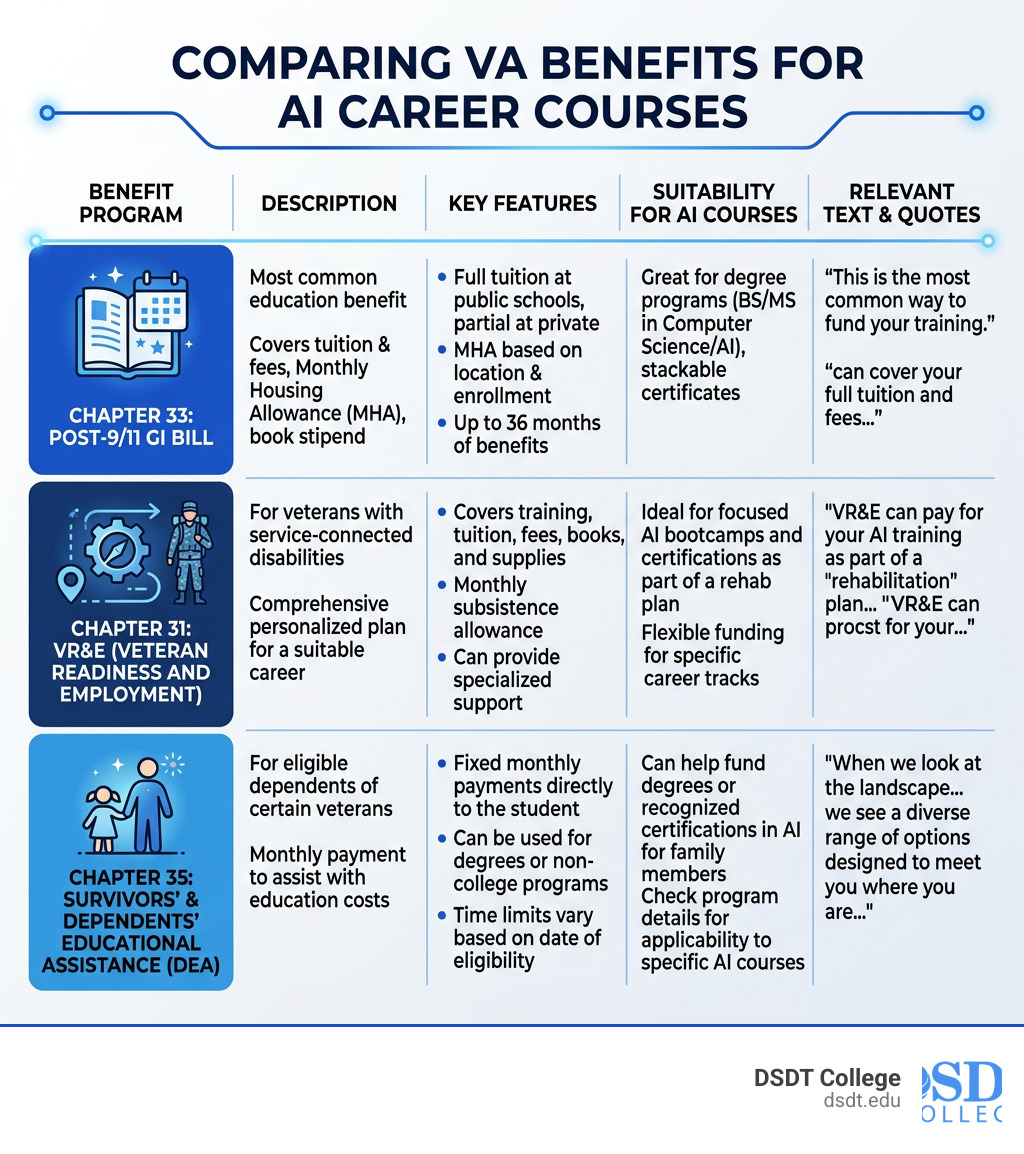
- Post-9/11 GI Bill® (Chapter 33): This is the most common way to fund your training. It can cover your full tuition and fees at public schools (and a large portion at private ones), plus provide a monthly housing allowance (BAH) and a stipend for books.
- Veteran Readiness and Employment (VR&E – Chapter 31): If you have a service-connected disability that limits your ability to work, VR&E can pay for your AI training as part of a “rehabilitation” plan to get you into a suitable career field.
- VET TEC: While often subject to funding availability, the VET TEC program is specifically designed for high-tech training. It doesn’t count against your GI Bill® entitlement months, making it a “free” way to gain AI skills if you have at least one day of GI Bill® eligibility left.
More info about tuition and financial aid
Eligibility and Time Commitments for Veteran AI Career Courses
Before you sign up, it’s important to understand the “ops tempo” of these programs.
- Short-Term Intensives: Introductory programs can take only 3 weeks and are virtual, making them easy to fit around a current job.
- Mid-Range Certifications: Many intensive bootcamp tracks run for about 90 days. These are often “full-time” commitments where you’ll be in labs for 40 hours a week.
- Extended Academic Tracks: Specialized certificate programs can take 17 weeks to a full year, usually requiring a few hours of work per week.
Most programs require an honorable discharge and at least 90 days of active duty service since September 10, 2001, to qualify for the “Forever GI Bill®” benefits.
Key Skills and Specializations in the AI Sector
The world of AI is broad. When you look into veteran AI career courses, you’ll likely find yourself choosing a “MOS” or specialization within the tech world.

- Machine Learning (ML): This is the “engine” of AI. You’ll learn to use Python and R to build models that can predict outcomes, like stock market trends or equipment failure in the field.
- Generative AI (GenAI): This is the “hottest” field right now. It involves working with Large Language Models (LLMs) like Gemini or ChatGPT to automate content creation and data analysis.
- Data Science: This is about finding the “signal in the noise.” You’ll use SQL to pull data from massive databases and Python to visualize it for leadership.
- Cloud Infrastructure: AI doesn’t run on a laptop; it runs on superclusters. Oracle recently launched a zettascale supercluster with over 131,000 NVIDIA GPUs. Learning how to manage these “cloud” environments is a high-demand skill.
More info about Machine Learning Specialist programs
Core Competencies in Veteran AI Career Courses
Regardless of your specialization, most veteran AI career courses will teach you a core set of competencies:
- Natural Language Processing (NLP): Teaching computers to understand human speech.
- Model Deployment: Taking an AI model and making it work in a real-world app.
- Ethical AI: Ensuring that the AI we build is fair and doesn’t have “bias.”
- Secure Software Development: In the military, security is everything. In AI, it’s no different. You’ll learn how to integrate AI solutions securely to protect sensitive data.
More info about AI Prompt Specialist programs
Translating Military Experience to AI Roles
You already have “hidden” AI skills. Think about it:
- Security Clearances: Many AI roles in the public sector require a clearance. If you already have one, you are instantly more valuable than a civilian candidate.
- Problem-Solving: AI is just a tool to solve a problem. Your experience evaluating high-stakes situations translates perfectly to “tuning” an AI model.
- Technical Communication: Being able to explain a complex mission to a commander is exactly like explaining an AI strategy to a CEO.
- National Security: As organizations like VetsinTech point out, integrating veterans into the AI ecosystem is a matter of national security. We need people who understand the mission to build the tools that support it.
Career Outlook: Salaries and Opportunities for Veterans in AI
Is the effort worth it? The data says yes. The demand for AI talent is “parabolic.” Oracle’s cloud growth is projected to be over 40% in 2026 due to AI demand. This means companies are desperate for people who can actually do the work.
- Machine Learning Engineer: Average salary is $158,000, with San Francisco roles reaching $191,000.
- Data Scientist: Median wage is $113,000.
- AI Solutions Architect: These roles often pay well over $170,000 as they involve designing the entire “big picture” for a company’s AI.
More info about Information Technology associate degrees
Transition Support and Job Placement Assistance
You don’t have to navigate this alone. Many veteran AI career courses include “wrap-around” services:
- AI Ready Veteran: This nonprofit uses custom GPTs to help you build a resume that civilians actually understand. They have “coaches” for career search, entrepreneurship, and even family support.
- LinkedIn Optimization: Many bootcamps include 1-on-1 mentoring to help you build a professional profile that attracts recruiters.
- Alumni Networks: Tapping into a network of veterans already working at Google, Oracle, or IBM is the fastest way to get a referral.
Frequently Asked Questions about Veteran AI Career Courses
Can I use the GI Bill® for AI bootcamps?
Yes! However, the program must be VA-approved. Many “non-traditional” schools and bootcamps are now approved under Chapter 33 or the VET TEC program. Always check with the school’s certifying official before enrolling to ensure your tuition and BAH will be covered.
Do I need a technical background to start an AI course?
No. Many programs are designed for beginners. Your military experience with logical reasoning and troubleshooting is often a better “foundation” than a computer science degree. If you can handle a complex mission plan, you can handle a Python script.
What are the highest-paying AI roles for veterans?
Machine Learning Engineers and AI Architects currently top the list. However, if you have a security clearance, a “Cybersecurity AI Analyst” role can be extremely lucrative, as you’ll be using AI to defend against state-sponsored digital threats.
Conclusion
The shift from military intelligence to artificial intelligence is more natural than you might think. Both require discipline, a focus on the mission, and the ability to adapt to new technology on the fly. Whether you are in Detroit, Michigan, or looking for online career training from Tampa, Florida, the opportunities in AI are waiting for you.
At DSDT College, we are committed to providing career-focused education that leads directly to employment. From our Detroit technology hub to our Midwest career pathways, we focus on hands-on learning and industry certifications that matter. If you are ready to stop “transitioning” and start “leading” in the civilian world, AI is the place to be.