
Understanding the ARRT Equation for Excellence
When we talk about how to get ARRT certified, we are talking about joining a prestigious group of healthcare professionals. The American Registry of Radiologic Technologists (ARRT) is the world’s largest credentialing organization that seeks to ensure high standards of patient care. Holding an ARRT credential isn’t just about having a certificate on your wall; it’s about signaling to employers and patients that you have mastered the knowledge and skills necessary to provide safe, effective medical imaging.
According to October 2024 census data, there are more than 355,000 ARRT registered technologists currently practicing. These professionals work in various disciplines, from traditional X-ray to advanced MRI. By meeting the Initial Requirements for Earning ARRT Credentials, you ensure your career has longevity and that you remain competitive in a growing job market. National standards set by the ARRT are recognized by almost every major healthcare employer in the U.S., making this certification the “gold standard” for the industry.
Choosing the Right Primary Eligibility Pathway to Get ARRT Certified
Before you dive into textbooks, you need to pick your path. The ARRT offers several “Primary Eligibility Pathways.” This is the route most people take to earn their very first credential. If you aren’t already a radiologic technologist, you will likely choose one of these six disciplines:
- Magnetic Resonance Imaging (MRI)
- Radiography (X-ray)
- Sonography (Ultrasound)
- Radiation Therapy
- Nuclear Medicine Technology
- Vascular Sonography
At DSDT College, we focus heavily on the MRI pathway. If you’re interested in a career that combines high-tech computer science with patient care, you can find more info about our MRI Technology Associate Degree, which is designed to lead you directly through the ARRT Primary Pathway. Choosing the right discipline early is vital because your educational program must be specifically approved for that exact credential.
Step 1: Navigating the Education Requirement
The first pillar of the ARRT equation is education. You can’t just study on your own and sit for the exam; you must graduate from an ARRT-approved educational program. This ensures you’ve received both the “didactic” (classroom) instruction and the “clinical” (hands-on) experience required to handle medical equipment safely.
To meet the Education requirement, you must earn an Associate degree or higher. This degree doesn’t necessarily have to be in radiologic sciences, but it must come from an institution accredited by an agency the ARRT recognizes. Most students find it most efficient to earn their Associate of Applied Science specifically in their field of study, such as MRI Technology.
Educational Qualifications and the Three-Year Rule
Timing is everything when learning how to get ARRT certified. The ARRT enforces what is known as the “Three-Year Rule.” This means you must establish your eligibility and apply for certification within three years of completing your educational program.
Starting January 1, 2025, there is a critical update: you must also earn your degree within three years of finishing your professional radiography or MRI coursework. If you finish your certificate but wait four years to finish your Associate degree, you might lose your eligibility to sit for the exam. We always recommend that our students stay on top of their academic transcripts and work closely with their Program Director. Your Program Director is the one who must ultimately verify to the ARRT that you have completed all didactic and clinical competencies.

Step 2: Clearing the Ethics Review Process
The ARRT takes “good moral character” very seriously. To protect patients, every applicant must comply with the ARRT Rules of Ethics. During your application, you will have to answer three specific questions regarding any past misdemeanors, felonies, or military court-martials. You also have to report any suspensions or dismissals from an educational program for reasons related to ethics.
If you have a “skeleton in your closet,” don’t panic—but don’t hide it either. In 2023, the ARRT completed approximately 1,730 ethics reviews, and less than 1% resulted in a revocation of credentials. The key is honesty. If you are concerned about a past mistake, you can submit an Ethics Review Preapplication up to eight months before you graduate. This costs a nonrefundable $100 fee, but it gives you peace of mind by letting you know if you are eligible before you pay the full application fee and spend months studying for the exam.
Step 3: How to Get ARRT Certified via the Examination
Once your education and ethics are cleared, it’s time for the final boss: the exam. The ARRT exam is a computer-based test administered at Pearson VUE testing centers. The standard application fee is $225. After the ARRT processes your application, they will send you a Candidate Status Report (CSR), which opens your “window” to schedule the test.
To satisfy the Examination requirement, you must achieve a scaled score of 75. A “scaled score” is not a simple percentage (like 75% correct); rather, it is a weighted score that accounts for the difficulty of the specific questions on your version of the test.

Preparing for the Exam and Question Formats
Preparation is the best way to reduce stress. The ARRT provides “Content Specifications,” which act as a blueprint for what will be on the test. We tell our students to treat these like a holy grail. The exams aren’t just multiple-choice; you may encounter various question formats, including “hot spot” questions (where you click on an image) or “sorting” questions.
Every exam begins with a tutorial. Do not skip this! It helps you get used to the software so you don’t make technical errors. Most exams also include “pilot questions”—unscored questions used for research. You won’t know which ones they are, so answer every question as if it counts. A typical MRI exam, for example, consists of 200 scored items and 20-30 pilot items, with a total testing time of about 3.5 to 4 hours.
Application Timelines and State Licensing Differences
A common point of confusion is the difference between ARRT certification and state licensing. Think of ARRT certification as your “national board” qualification and state licensing as your “permission to work” in a specific location.
| Feature | ARRT Certification | State Licensing |
|---|---|---|
| Scope | National recognition | State-specific legal permission |
| Requirement | Education, Ethics, Exam | Varies by state; often requires ARRT |
| Maintenance | Continuing Education (CE) every 2 years | Renewal fees and state-specific CE |
| Purpose | Professional credentialing | Public safety and regulation |
In many states, like Michigan or Florida, you need both. You can find more details on APPLYING FOR STATE LICENSING through the ARRT website, as the ARRT actually administers the licensing exams for many state entities.
Managing Your Timeline to Get ARRT Certified
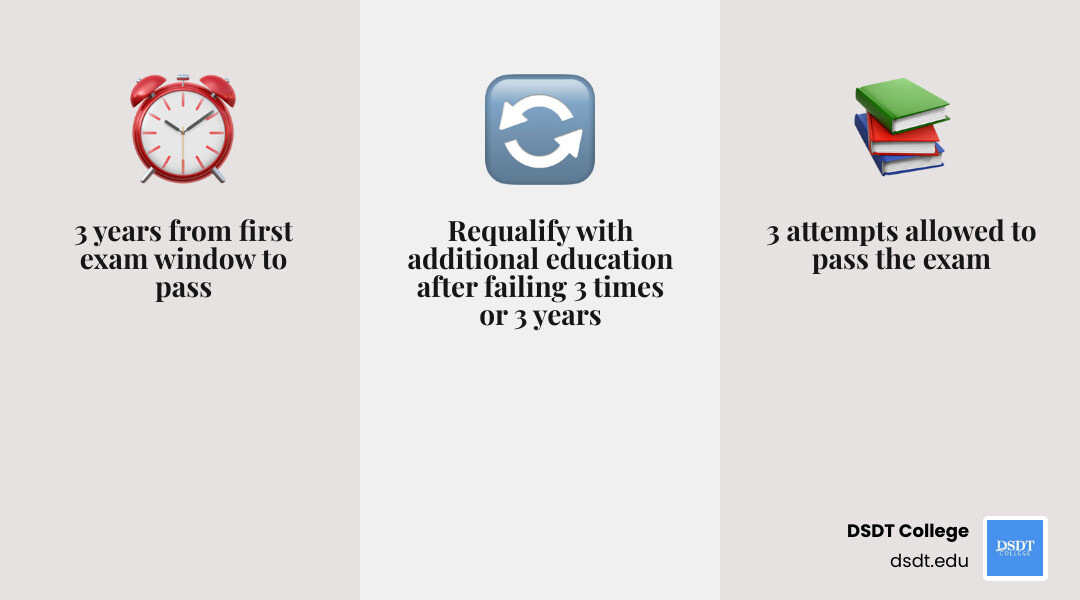
You have a limited number of “lives” when it comes to the exam. You are allowed three attempts to pass the ARRT exam within a three-year period, starting from the date your first exam window opens. If you fail three times, or if the three years pass, you must “requalify” by completing additional education.
To keep your timeline smooth, ensure your legal name on your ARRT account matches your ID exactly. If your ID says “Jonathan A. Smith” but your application says “John Smith,” the testing center will turn you away, and you might lose your fee. If you move or change your name during the process, update your ARRT online account immediately to avoid delays.
Frequently Asked Questions about ARRT Certification
Can I use a prior degree like a Bachelor’s in Kinesiology?
Yes! If you already have a Bachelor’s degree in a field like Kinesiology or Biology, you have already met the “degree” portion of the education requirement. However, you still must complete an ARRT-approved professional program in a specific discipline like Radiography or MRI. Your prior credits may help you skip general education classes, but they won’t bypass the 2,000+ hours of clinical training required for imaging.
What happens if I fail the ARRT exam three times?
If you don’t pass within three attempts, you are no longer eligible for that discipline under your current application. You will have to go back to school for “requalification.” This usually involves a specific set of new classes or clinical hours. It’s a tough spot to be in, which is why we emphasize rigorous study and using the ARRT content specifications from day one.
Is the ARRT exam the same as my state’s licensing exam?
Often, yes. Many states use the ARRT exam as their own licensing test. However, passing the exam for a state license does not automatically grant you ARRT certification. To get the “R.T.” or “R.R.A.” title after your name, you must apply directly to the ARRT and meet all their specific education and ethics requirements.
Conclusion
Learning how to get ARRT certified is the first step toward a stable, high-paying career in healthcare. Whether you are a high school graduate in Detroit looking for a practical career or a veteran in San Antonio transitioning to civilian life, the path is clear: Education, Ethics, and Examination.
At DSDT College, we pride ourselves on being more than just a school; we are a career-focused institution that aligns our training with the needs of the modern workforce. From our MRI Technology programs to our IT and Cybersecurity certifications, we provide the hands-on learning and flexible options you need to succeed.
If you’re ready to stop wondering and start doing, more info about our programs is just a click away. Let us help you navigate the ARRT equation and get you into the clinic with confidence.