


Why Choosing the Best Platform to Learn Cyber Security Changes Everything
The best platform to learn cyber security depends on your current skill level and goals. Most successful learners find that a combination of different training styles works best:
- Gamified Learning: Ideal for beginners to build muscle memory through interactive challenges.
- Lab-Based Simulations: Essential for intermediate learners to practice in virtualized enterprise environments.
- Certification Prep: Focused training designed to help you pass industry-standard exams like CompTIA Security+.
- Expert-Led Instruction: Advanced training for those looking to specialize in high-level security architecture.
No single tool does everything. Most successful learners combine hands-on practice with a structured academic program to ensure they are truly job-ready.
Cybersecurity is one of the fastest-growing fields in tech. But with dozens of resources promising to get you job-ready, it is hard to know where to start, especially if you have no IT background.
Some resources are built for total beginners. Others assume you already know your way around a network. Some focus on attacking systems (offensive security). Others train you to defend them (SOC and blue team work).
The wrong choice wastes time and money. The right one can move you toward a real career faster than you think. One learner reported landing entry-level interviews after just two months of hands-on practice on the right training platforms.
This guide breaks down what actually works, and for whom.
I’m Jamie Kothe, an academic leader and workforce development professional at DSDT College, where I help adult learners, veterans, and career changers find the best platform to learn cyber security and build real, employer-ready skills. My work focuses on connecting students to programs that align with what today’s IT and cybersecurity employers actually need.
The Essential Role of Hands-On Learning in Cybersecurity
If you want to work in cybersecurity, reading a textbook isn’t enough. You have to actually do the work. The industry has shifted away from passive video watching toward immersive, browser-based training. This is where you log into a virtual machine and actually try to find vulnerabilities or defend a network in real-time.
Research shows that the most effective learning happens through interactive exercises based on real-world scenarios. This includes “hacking” machines or investigating simulated attacks. These environments allow you to make mistakes in a safe, controlled space before you ever touch a live corporate network.
At DSDT College, we believe that hands-on hacking with real-world exercises is the only way to build true competence. Whether you are in Detroit, Michigan, or studying through our programs in Dallas or Tampa, we prioritize this immersive approach. We don’t just want you to know the theory; we want you to have the muscle memory to respond when a real threat emerges.

Engaging Learning: Gamification and Interactive Environments
One of the biggest hurdles for beginners is staying motivated. Cybersecurity can be dense and intimidating. That is why the best platform to learn cyber security for many people is one that uses “gamification.”
Modern training tools have revolutionized this by turning lessons into a game. You earn points, climb leaderboards, and “unlock” new levels. This approach is incredibly beginner-friendly, offering paths for both offensive security (red teaming) and defensive certifications (blue teaming).
Many of these tools offer a “freemium” model. You can start with a free tier to see if you like it, then upgrade to a subscription to access more advanced labs. We often encourage our students to supplement their formal DSDT coursework with these gamified labs to keep their skills sharp and their engagement high.
Mastering Advanced Skills: Real-World Labs and Simulations
Once you move past the basics, you need environments that replicate the complexity of an enterprise network. Advanced learners use specialized lab environments for:
- Capture The Flag (CTF) Scenarios: Defensive CTF scenarios available for instant assessment.
- Purple Teaming: Training where offensive and defensive teams work together to improve security.
- Penetration Testing: Specialized tracks in Active Directory (AD), Web Pentesting, and Cryptography.
These environments aren’t just for individuals; they are used by major organizations to validate the readiness of their security teams. At DSDT College, we integrate these high-level simulations into our advanced curriculum, ensuring our students can handle multi-stage threats that exploit entire networks.
Starting Your Cybersecurity Journey: Foundational Training
Many people ask if they can start with zero IT experience. The answer is yes, but you shouldn’t jump straight into advanced hacking. You need a foundation.
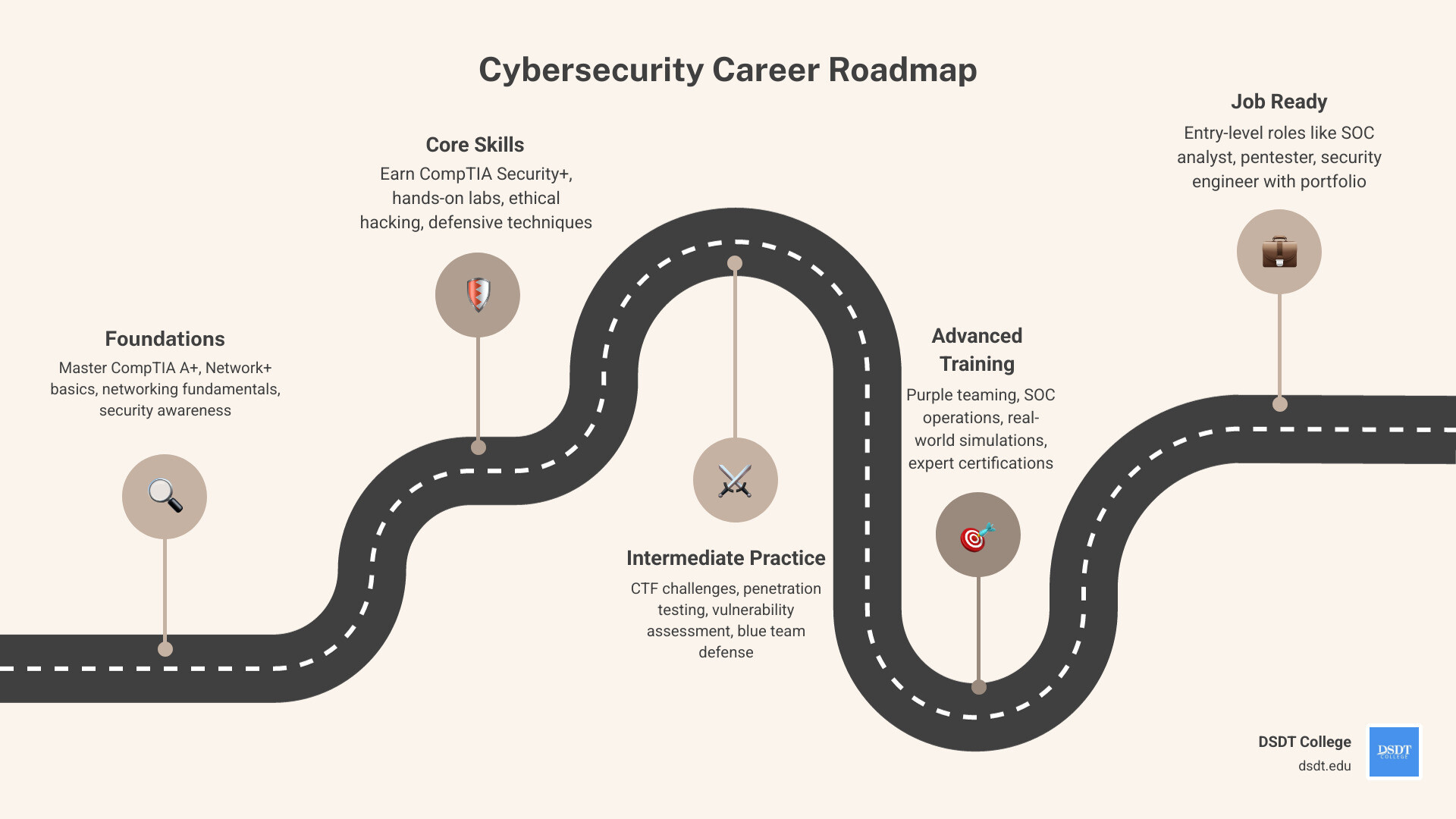
The standard “entry-level” path usually starts with three core certifications from CompTIA:
- A+: The basics of hardware and troubleshooting.
- Network+: How computers actually talk to each other.
- Security+: The fundamental principles of cybersecurity.
Without understanding how a network functions, you cannot effectively defend it. Leading training providers offer excellent role-based paths that start with these basics. They focus on “Learn, Practice, Prove”—giving you the content, the labs, and the assessments to ensure you’ve actually mastered the material.
DSDT College’s comprehensive beginner programs are designed specifically for this. We serve high school graduates and career changers in markets like Chicago, Columbus, and Philadelphia, providing the structured environment needed to move from “zero” to “certified.”
Cutting-Edge Training: Advanced Concepts and AI Cyber Ranges
The threat landscape is changing, and the best platform to learn cyber security must now include Artificial Intelligence (AI). We are seeing a rise in deepfake voice and video scams, as well as “urgent CEO” phishing attacks powered by AI.
To combat this, the industry is moving toward AI-powered cyber ranges. These ranges allow professionals to test the capabilities of autonomous AI security agents in a controlled environment. Furthermore, new curricula are focusing on the NIST AI Risk Management Framework (AI RMF) and secure AI deployment.
At DSDT College, we stay at the forefront of these trends. Our curriculum includes:
- Deepfake Detection: Learning to spot AI-generated fraud.
- AI Governance: Understanding how to use AI securely within a business.
- SOC Readiness: Training for Security Operations Center (SOC) work using the latest threat intelligence.
Maximizing Your Investment: Career Effectiveness and Value
When choosing a platform, you have to look at the return on investment (ROI). While free video resources are incredible for learning theory, they often don’t provide the hands-on labs that land you a job.
Real users on Reddit often suggest a “mixed” budget. For example, spending a small monthly fee on a lab-heavy platform while using free videos for theory. However, for those who want a direct path to employment, a structured college program often provides better long-term value.
DSDT College offers a value proposition that self-study platforms can’t: Accreditation and Career Services. While a subscription might give you a badge, our programs lead to industry-recognized certifications and associate degrees. We focus on high-intent career training that leads directly to employment in high-demand industries across the Midwest and beyond.
Your Path to Employment: DSDT College’s Career-Focused Approach
If you are in Detroit, Grand Rapids, or Lansing, you know that the Michigan tech scene is booming. But the same is true for our students in Phoenix, Seattle, and Miami. Employers aren’t just looking for someone who “knows” cybersecurity; they want someone who can prove it.
Our Technology Professional 6 Program is specifically designed to get you ready for the workforce. We focus on the certifications that matter—CompTIA A+, Network+, and Security+—while providing the hands-on lab environment that mimics real-world SOC work.
We serve a diverse audience:
- High School Graduates: Seeking an alternative to a traditional four-year degree.
- Adult Learners: Looking for a flexible way to change careers.
- Military Veterans: Transitioning into civilian IT roles with specialized support.
Frequently Asked Questions about Cybersecurity Platforms
Can I learn cybersecurity with zero experience?
Yes! Everyone starts somewhere. The key is to start with IT foundations (like the CompTIA A+ curriculum) before trying to learn advanced hacking. Many beginner-friendly platforms are specifically designed for people with zero prior knowledge.
Which platform is best for landing a job?
There is no “magic” platform, but the best platform to learn cyber security is the one that helps you earn industry-standard certifications. Most employers look for the CompTIA Security+ as a baseline. Combining a certification prep resource with a hands-on lab environment is a winning strategy.
Are free cybersecurity resources enough?
Free resources like educational YouTube channels, edX, and free tiers of lab platforms are amazing for learning the “what” and “why.” However, to learn the “how,” you usually need the advanced, paid labs that simulate real-world networks. Most successful professionals use a mix of both.
Conclusion
The journey to becoming a cybersecurity professional is a marathon, not a sprint. Whether you choose a gamified platform to get started or dive into advanced AI cyber ranges, the most important step is to start practicing today.
If you are looking for a structured, career-focused environment that combines the best of these platforms with expert instruction and career support, we are here to help. From Detroit to Dallas, DSDT College is committed to your success.
Start your career training at DSDT College and take the first step toward a secure, high-paying future in tech.