


Why the CISSP Risk Management Framework Belongs in Every Security Pro’s Toolkit
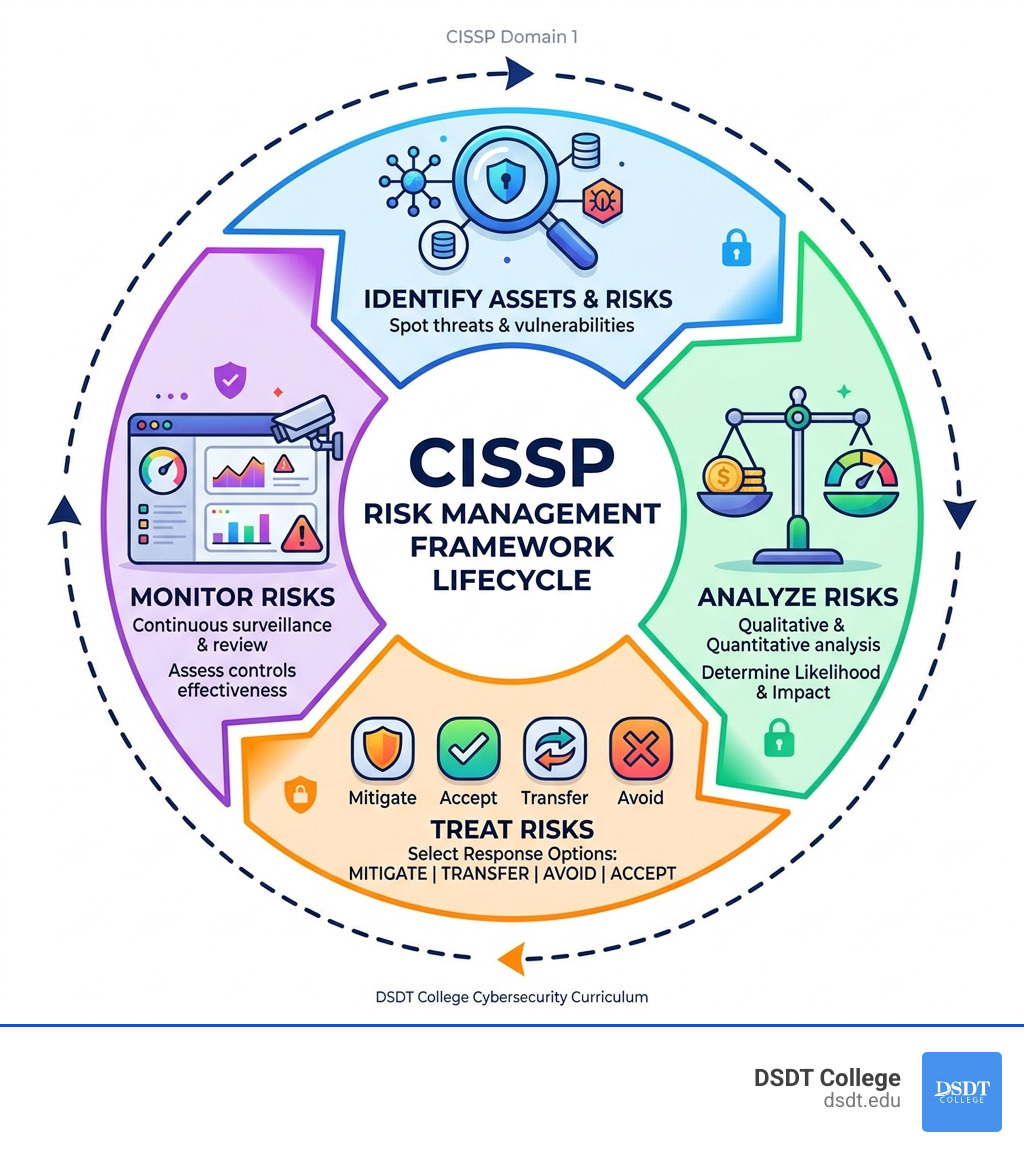
The CISSP risk management framework is a structured approach to identifying, analyzing, and responding to security risks inside an organization. Here’s a quick snapshot of what it covers:
What the CISSP Risk Management Framework includes:
- Domain 1 (Security and Risk Management) – the largest CISSP exam domain, covering governance, compliance, and risk
- Risk identification – spotting threats, vulnerabilities, and assets
- Risk analysis – measuring likelihood and impact (qualitative and quantitative)
- Risk treatment – deciding to avoid, mitigate, transfer, or accept risk
- Standards alignment – connecting to frameworks like NIST SP 800-37, ISO 31000, and COBIT
- Ongoing monitoring – treating risk management as a continuous cycle, not a one-time task
Think of it this way: every data breach, ransomware attack, and compliance failure you read about in the news traces back to a risk management gap somewhere. The CISSP framework exists to close those gaps before they become headlines.
Whether you are exploring a career in cybersecurity or preparing for the CISSP exam, understanding how risk management works is the foundation everything else is built on. Get this right, and the rest of the certification — and the career — starts to make a lot more sense.
I’m Jamie Kothe, an academic leader at DSDT College, where I help develop career-focused programs that prepare students for high-demand fields like cybersecurity — including curriculum built around the CISSP risk management framework. My work connecting industry standards to practical training gives me a front-row seat to what employers actually need from security professionals. Let’s break down exactly how this framework works so you can build on a solid foundation.
Foundations of Security and Risk Management (Domain 1)
When we talk about the CISSP risk management framework, we are essentially diving into the heart of Domain 1 of the CISSP Common Body of Knowledge (CBK). This domain is the “north star” for security professionals. It sets the stage for how an organization protects its most valuable assets.
At the core of this foundation is the CIA Triad. No, we aren’t talking about secret agents; we’re talking about Confidentiality, Integrity, and Availability.
- Confidentiality ensures that sensitive information is only accessible to those authorized to see it.
- Integrity guarantees that data hasn’t been tampered with or altered.
- Availability means that systems and data are ready for use when the business needs them.
Beyond the triad, we also focus on Authenticity (verifying users are who they say they are) and Nonrepudiation (ensuring someone cannot deny they took a specific action, like sending an email or signing a digital contract).
But security doesn’t exist in a vacuum. We practice security governance to ensure our technical goals align with the business’s goals. If the security team is moving left while the CEO is moving right, the organization is at risk. Effective governance ensures that security supports the mission of the company, whether that’s providing MRI services in Detroit or managing logistics in Jacksonville. To see exactly how these concepts are tested, you can review the ISC2 CISSP Exam Outline.
Core Components of Risk Analysis and Valuation
Before we can protect anything, we have to know what we are protecting and what we are protecting it from. This is where asset valuation comes in. We can’t spend $10,000 to protect a $500 laptop; that just doesn’t make sense!

To master the CISSP risk management framework, we must understand these four key terms:
- Asset: Anything of value to the organization (data, hardware, people).
- Threat: A potential cause of an unwanted incident (hackers, storms, human error).
- Vulnerability: A weakness in an asset or control that can be exploited by a threat.
- Impact: The “ouch” factor—how much it hurts if the threat exploits the vulnerability.
We also look at the Likelihood (how often it might happen) and the Exposure Factor (EF), which represents the percentage of loss a realized threat would cause to a specific asset.
Qualitative vs. Quantitative Risk Analysis
We generally use two ways to measure risk. Here is a quick comparison:
| Feature | Qualitative Analysis | Quantitative Analysis |
|---|---|---|
| Data Type | Subjective (High, Medium, Low) | Objective (Numeric, Dollar Values) |
| Method | Brainstorming, Interviews, Delphi Technique | Mathematical Formulas |
| Speed | Faster to perform | Takes more time and data |
| Best For | Prioritizing risks quickly | Calculating ROI for security spending |
Quantitative Analysis and the ALE Formula
If you love math, this is your time to shine. If you don’t, don’t worry—it’s simpler than it looks. The goal of quantitative analysis within the CISSP risk management framework is to put a dollar sign on risk.
The primary formula we use is the Annualized Loss Expectancy (ALE). To get there, we first need the Single Loss Expectancy (SLE).
- SLE = Asset Value × Exposure Factor
- ALE = SLE × Annualized Rate of Occurrence (ARO)
For example, if a server is worth $10,000 (Asset Value) and a fire would likely destroy 50% of it (EF), your SLE is $5,000. If history tells us a fire happens once every 10 years (ARO of 0.1), your ALE is $500. This tells the business that spending more than $500 a year on fire suppression for that specific server might not be a good cost-benefit analysis.
Navigating the CISSP Risk Management Framework and Global Standards
While “the framework” is a general concept in the CISSP, it is built upon several world-class standards. We don’t have to reinvent the wheel; we just have to choose the right one for our organization.
- ISO 31000: A global standard that provides principles and generic guidelines on risk management. You can learn more at the ISO 31000 Risk Management Standards page.
- COSO: Often used for internal auditing and fraud prevention.
- COBIT: A framework specifically for IT governance and management.
- FAIR: Focused on understanding the factors that contribute to risk and how they affect each other.
- OCTAVE: A self-directed risk evaluation method that focuses on organizational risk.
Deep Dive into the NIST SP 800-37 CISSP Risk Management Framework
One of the most important frameworks for any cybersecurity student in the U.S. is the NIST Risk Management Framework (RMF). It’s a 7-step process that ensures security is baked into the system from day one.
- Prepare: Carry out essential activities at the organization, mission, and system levels to help manage security and privacy risks.
- Categorize: Determine the impact if the system or data is lost or compromised.
- Select: Choose the initial set of controls to protect the system.
- Implement: Put the controls in place and document how they work.
- Assess: Determine if the controls are implemented correctly and operating as intended.
- Authorize: A senior official makes the decision to allow the system to operate based on the risk.
- Monitor: Continuously check the controls and the environment for changes.
For the full technical breakdown, we always recommend checking the NIST SP 800-37 RMF Guidelines.
Selecting Controls within a CISSP Risk Management Framework
Choosing controls isn’t a “one size fits all” situation. We use Scoping to decide which controls are relevant and Tailoring to adjust them to fit our specific needs. We start with a Baseline (a minimum level of security) and then categorize controls as:
- Common controls: Provided by the organization (e.g., a physical building security guard).
- System-specific controls: Unique to one system (e.g., a specific database encryption).
- Hybrid controls: A mix of both.
Risk Treatment Strategies and Security Control Categories
Once we know what the risks are, we have to decide what to do with them. This depends on our risk appetite (how much risk we are willing to take to achieve our goals) and risk tolerance (the variance we can handle).
There are four main ways we treat risk:
- Avoid: Stop doing the activity that causes the risk (e.g., if a software is too risky, don’t use it).
- Mitigate: Use security controls to reduce the risk to an acceptable level.
- Transfer: Give the risk to someone else (e.g., buying cyber insurance).
- Accept: Acknowledge the risk and do nothing because the cost of protection is higher than the potential loss.
After we apply these strategies, the risk that remains is called residual risk.
Security Control Types and Functions
Controls are the “tools” in our toolkit. We categorize them by what they do:
- Preventive: Stops an incident before it happens (Firewalls, locks).
- Detective: Identifies an incident as it happens or after (Alarms, logs).
- Corrective: Fixes a system after an incident (Reinstalling an OS).
- Deterrent: Discourages someone from attacking (Warning signs).
- Recovery: Restores functionality (Backups).
- Compensating: A “Plan B” when a primary control can’t be used.
We also group them by how they are implemented:
- Administrative: Policies, procedures, and training.
- Technical (Logical): Software and hardware settings like encryption.
- Physical: Real-world barriers like fences and cameras.
Advanced Assessment: Threat Modeling and Business Impact Analysis
As you progress in your cybersecurity career, you’ll move beyond simple checklists to advanced modeling.
Threat Modeling is the process of looking at an application or system from the perspective of an attacker. We use frameworks like:
- STRIDE: Spoofing, Tampering, Repudiation, Information Disclosure, Denial of Service, and Elevation of Privilege.
- PASTA: Process for Attack Simulation and Threat Analysis (a risk-centric approach).
- DREAD: A legacy way of rating threats based on Damage, Reproducibility, Exploitability, Affected users, and Discoverability.
We also have to consider the Business Impact Analysis (BIA). This helps us understand the “Maximum Tolerable Downtime” (how long can the business be down before it goes out of business?) and the “Recovery Time Objective” (how fast do we need to get back up?).
Finally, don’t forget Supply Chain Risk Management. Your security is only as good as the security of your vendors. If you are a student in Phoenix or Seattle working for a tech firm, you’ll likely spend a lot of time ensuring your software providers are following the same CISSP risk management framework standards that you are.
Frequently Asked Questions about CISSP Risk Management
What is the difference between due care and due diligence?
This is a classic CISSP question! Due care is doing the right thing in the moment (acting like a “reasonable person”). Due diligence is the research and practice that goes into making sure you can provide due care (e.g., checking logs, performing audits). Think of it this way: Due diligence is the homework; due care is the action.
How do you calculate Annualized Loss Expectancy (ALE)?
As mentioned earlier, use the formula: ALE = SLE × ARO. First, find the Single Loss Expectancy (Asset Value x Exposure Factor). Then, multiply that by how many times a year you expect the event to happen. If it happens once every two years, your ARO is 0.5.
What are the 7 steps of the NIST RMF?
The 7 steps are: Prepare, Categorize, Select, Implement, Assess, Authorize, and Monitor. This cycle ensures that security is a continuous process rather than a “set it and forget it” task.
Conclusion
Mastering the CISSP risk management framework is more than just passing an exam; it’s about developing a mindset that protects organizations from real-world harm. Whether you are a veteran transitioning into civilian life in Colorado Springs or a high school graduate in Detroit looking for a high-growth career, cybersecurity offers a path to stability and impact.
At DSDT College, we are committed to providing the hands-on training and certification prep you need to succeed. Our programs are designed to align with industry standards, helping you move from the classroom directly into a career in information technology or cybersecurity.
If you’re ready to take the next step and learn more about how we can help you prepare for certifications like Security+ and eventually the CISSP, check out our More info about cybersecurity courses page. Your future in tech starts with a solid foundation in risk management—let’s build it together.