
Your GI Bill® Can Pay for Software Development Training — Here’s What to Know
GI Bill® software development programs are a real, funded path into one of today’s most in-demand careers — and more veterans qualify than you might think.
Quick Answer: Can You Use the GI Bill® for Software Development?
| Question | Answer |
|---|---|
| Can the GI Bill® pay for coding bootcamps? | Yes, at VA-approved schools |
| Can the GI Bill® pay for a CS degree? | Yes, at accredited colleges |
| Does it cover housing during training? | Yes, via Monthly Housing Allowance (MHA) |
| How long are benefits available? | Up to 36 months |
| Do you need 100% eligibility to qualify? | No, partial eligibility still provides benefits |
| Is VET TEC still available? | No, the VET TEC pilot program ended in 2024 |
The GI Bill® has paid out roughly $400 billion to more than 25 million veterans since 1944. Today, that same benefit can fund your path into software development — whether through an intensive coding bootcamp or a full computer science degree.
But not all programs qualify, and the rules around tuition coverage, housing stipends, and benefit usage can be confusing. This guide breaks it all down in plain language so you can make the right call for your situation.
I’m Jamie Kothe, an academic and workforce development professional at DSDT College, where I help veterans and career changers access industry-aligned training in fields like GI Bill® software development, information technology, and cybersecurity. My work focuses on connecting students to programs that meet VA standards and lead to real employment outcomes, so I’ll walk you through exactly what you need to know.
Understanding Your Benefits for GI Bill® Software Development
Navigating the Department of Veterans Affairs (VA) can sometimes feel like reading a manual written in a language that is almost, but not quite, English. When we talk about GI Bill® software development, we are usually looking at three main “flavors” of benefits. Understanding which one you hold is the first step to deploying your new career.
The most common benefit today is the Post-9/11 GI Bill®, also known as Chapter 33. This program provides educational benefits to those who served on active duty on or after September 11, 2001. If you served at least 90 days, you likely qualify for a percentage of these benefits. If you served at least 36 months, you are 100% eligible.
Then there is the Forever GI Bill® (The Harry W. Colmery Veterans Educational Assistance Act). Passed in 2017, this was a game-changer because it eliminated the 15-year expiration date for those whose last day of active duty was on or after January 1, 2013. It also expanded benefits for STEM programs, which is a huge win for anyone pursuing GI Bill® software development.
Finally, the Montgomery GI Bill® (MGIB) still exists for some. Unlike the Post-9/11 version, which pays tuition directly to the school and gives you a housing stipend, the MGIB usually pays a monthly flat rate directly to you, and you are responsible for paying the school.
Eligibility Requirements for GI Bill® Software Development
To get started, the VA looks at a few key factors:
- Service Time: Generally, a minimum of 90 days of active duty service is required.
- Discharge Status: You must have an honorable discharge.
- Entitlement: Most veterans start with 36 months of full-time benefits.
- Purple Heart Recipients: If you received a Purple Heart on or after 9/11, you may be eligible for the full 100% benefit rate regardless of length of service.
Before you can enroll in a full stack developer program, you need to obtain your Certificate of Eligibility (CoE). Think of this as your “golden ticket.” It tells us exactly how much the VA will pay and for how long. You can apply for this online through the VA website.
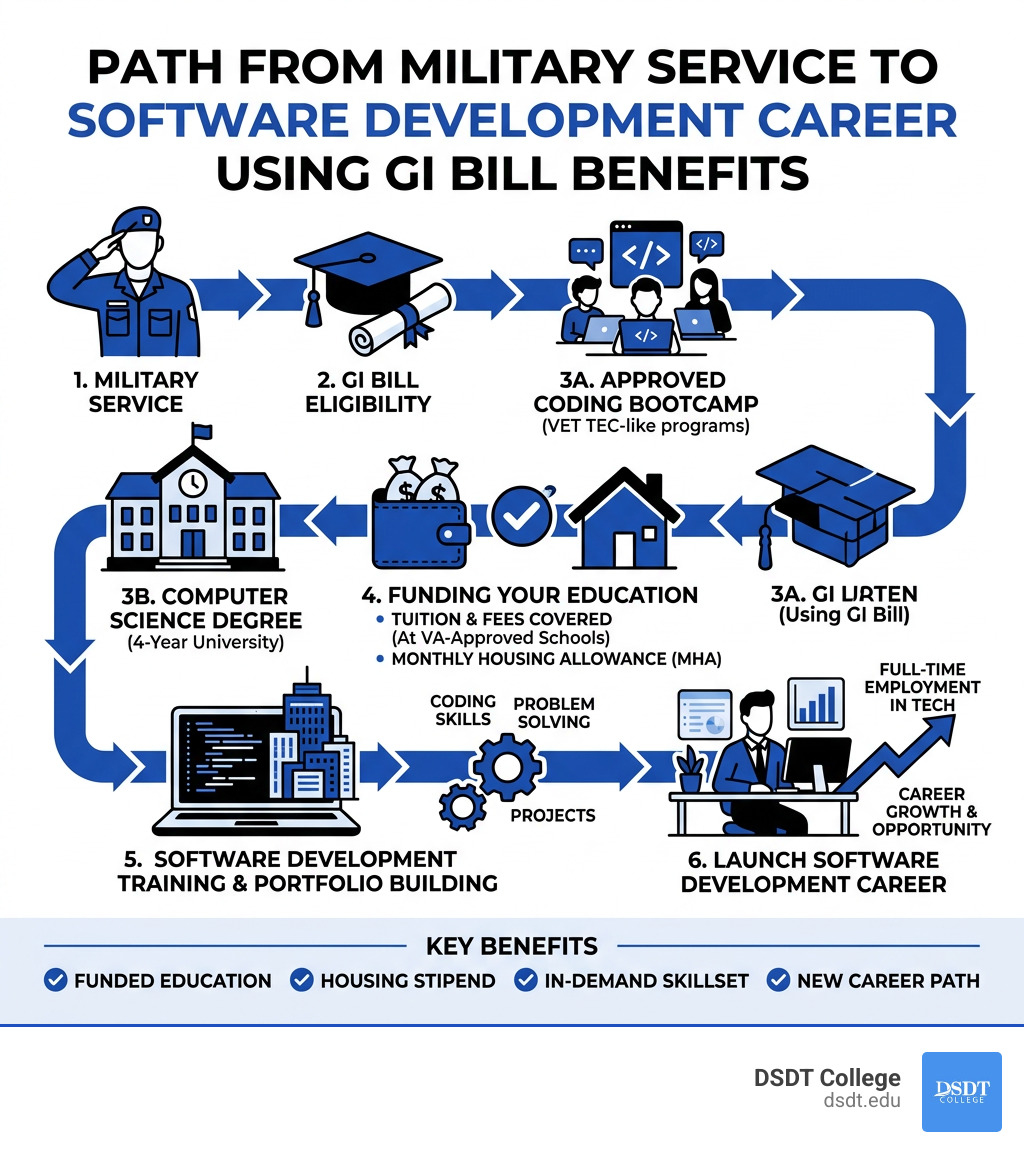
One important note for 2024: The VET TEC pilot program, which many veterans used for high-tech training without touching their GI Bill® days, has officially ended. As of April 1, 2024, no new enrollments are being accepted. This means that using your standard GI Bill® entitlement is now the primary way to fund your tech transition.
Career Support for GI Bill® Software Development Students
We know that a certificate or a degree is just a piece of paper if it doesn’t lead to a paycheck. That’s why we emphasize that GI Bill® software development training must include robust career services.
Military veterans often make excellent software engineers because of the discipline, problem-solving skills, and “mission-first” mentality honed in service. However, translating “Squad Leader” into “Scrum Master” on a resume takes work. Look for programs that offer:
- Portfolio Building: Real-world projects you can show to hiring managers.
- 1:1 Mentoring: Access to instructors who have actually worked in the industry.
- Job Placement Services: Active help finding roles in cities like Detroit, Chicago, or Columbus.
- Resume and Interview Prep: Learning how to explain your military experience in a way that tech recruiters understand.
Coding Bootcamps vs. Degrees: Choosing Your Path
This is the big debate: Should you spend four years getting a Bachelor’s in Computer Science, or 12 to 20 weeks in an immersive coding bootcamp? Both are valid paths for GI Bill® software development, but they serve different goals.
| Feature | Coding Bootcamp | Computer Science Degree |
|---|---|---|
| Duration | 12–20 weeks | 4 years |
| Focus | Practical, job-ready coding skills | Theory, math, and broad engineering |
| Cost | Lower total cost, high “burn” of GI Bill® | Higher total cost, uses more months |
| Housing (BAH) | Paid for the duration of the course | Paid during semesters/terms |
| Job Readiness | Immediate entry-level roles | Broad career options, research, or management |
The VA GI Bill® Comparison Tool is an essential resource here. It allows you to see exactly how much housing allowance (MHA) you will receive at a specific location. For example, if you attend an in-person program in Detroit or New York City, your MHA is calculated based on the ZIP code of the school and is equivalent to the Basic Allowance for Housing (BAH) for an E-5 with dependents.
The job market outlook remains strong despite headlines about “tech layoffs.” In fact, demand for full-stack developers is projected to grow significantly, with hundreds of thousands of new roles expected by the end of 2024. Entry-level salaries for software developers often start around $65,000, while the national median for experienced engineers sits well over $100,000.
How to Apply and Maximize Your GI Bill® Benefits
Ready to pull the trigger? The application process is straightforward but requires attention to detail.
- Apply via VA.gov: You’ll need your Social Security number, bank account information for direct deposit, and your military history (including your DD-214).
- Wait for your CoE: It usually takes the VA about 30 days to process your application and mail your Certificate of Eligibility.
- Choose your program: Whether you want an information technology associate degree or a software-specific certificate, ensure the school is VA-approved.
- Enrollment Verification: Once you start, the school must certify your enrollment to the VA so your tuition is paid and your housing checks start arriving.
To maximize your benefits, check out the VA education benefit rates to see current payment caps. If you find a program that costs more than the GI Bill® covers, look for schools participating in the Yellow Ribbon Program. These schools agree to split the remaining tuition costs with the VA, often resulting in $0 out-of-pocket for the veteran.
There are also specific programs like the STEM Extension, which can provide up to 9 months (or $30,000) of additional benefits for students in high-demand tech fields who have exhausted their initial 36 months of entitlement.
For military families, Chapter 35 (Survivors’ and Dependents’ Educational Assistance) provides funding for the spouses and children of veterans who are permanently and totally disabled due to a service-related condition or who died while on active duty. This is a powerful way to get the whole family into the tech economy.
Frequently Asked Questions about GI Bill® Software Development
Can I use the GI Bill® for online software development programs?
Yes! However, there is a catch. If you are 100% online, your Monthly Housing Allowance (MHA) is typically half of the national average BAH rate. To get the full “in-person” housing rate, many veterans choose “hybrid” programs or attend at least one class at a physical campus in locations like Detroit, San Antonio, or Virginia Beach.
How much is the housing allowance for coding bootcamps?
Your MHA is based on the school’s ZIP code. For an in-person, full-time student, it is equal to the BAH for an E-5 with dependents. If you are in a high-cost area like Seattle or Boston, this can be a significant amount of money that helps you focus entirely on your studies without needing a side job.
What happens if my GI Bill® benefits run out during a program?
If you are using the Post-9/11 GI Bill® and your benefits expire in the middle of a semester, the VA will often continue to pay through the end of that term. For shorter bootcamps, you may need to look into veteran-specific scholarships or the STEM extension mentioned earlier. Some schools also offer “Veteran Discounts” or internal scholarships to help bridge the gap.
Conclusion
Transitioning from the military to the civilian workforce is a major operation. At DSDT College, we specialize in making that transition as smooth as possible. Whether you are in our home base of Detroit or joining us from other Midwest hubs like Cleveland or Chicago, our focus is on practical, career-aligned education.
We don’t just teach you how to code; we prepare you for the certifications and real-world scenarios that employers actually care about. From career training programs in software development to cybersecurity and even healthcare imaging, we are here to help you deploy your future.
You’ve served your country; now it’s time to let your benefits serve you. Reach out to our admissions team today to see how we can help you turn your military experience into a thriving career in tech.