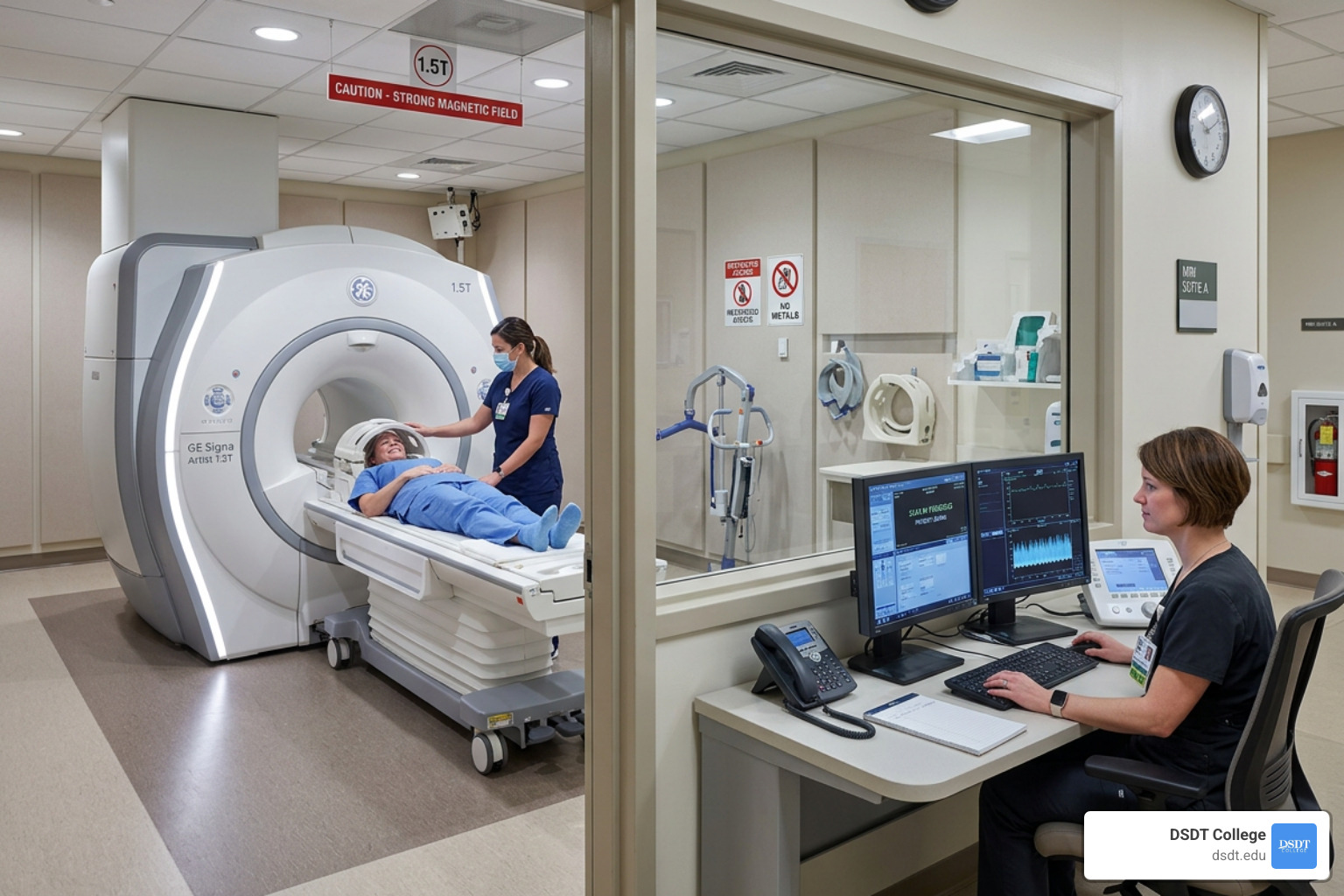
What Is Entry Level Online MRI Training — and Is It Right for You?
Entry level online MRI training gives you a structured path into one of healthcare’s fastest-growing careers — without needing prior radiology experience to get started.
Here are the most common entry-level online MRI program options available today:
| Program Type | Duration | Best For |
|---|---|---|
| Certificate (hybrid) | 6–9 months | Career changers, radiographers |
| Diploma program | 18 months | High school grads, new students |
| Short online course | 10 weeks | Cross-training, ARRT prep |
| Self-paced online cert | 1–2 months | Foundational knowledge only |
Quick facts for new students:
- Most programs combine online coursework with hands-on clinical training
- Graduates can pursue the ARRT (MR) or ARMRIT certification exams
- Median annual salary for MRI technologists is $83,740 (BLS, May 2023)
- Job growth is projected at 7% through 2029 — with some states like Arizona seeing up to 39% growth
Whether you’re a high school graduate, a career changer, a veteran, or someone already working in healthcare, there is a program format designed to fit your situation.
I’m Jamie Kothe, an academic and workforce development leader at DSDT College, where I help adult learners, veterans, and career changers find clear pathways into high-demand fields — including entry level online mri training. My work connecting students to allied health programs and employer partners gives me a practical view of what it actually takes to go from zero experience to a credentialed MRI technologist.
Choosing the Right Entry Level Online MRI Program
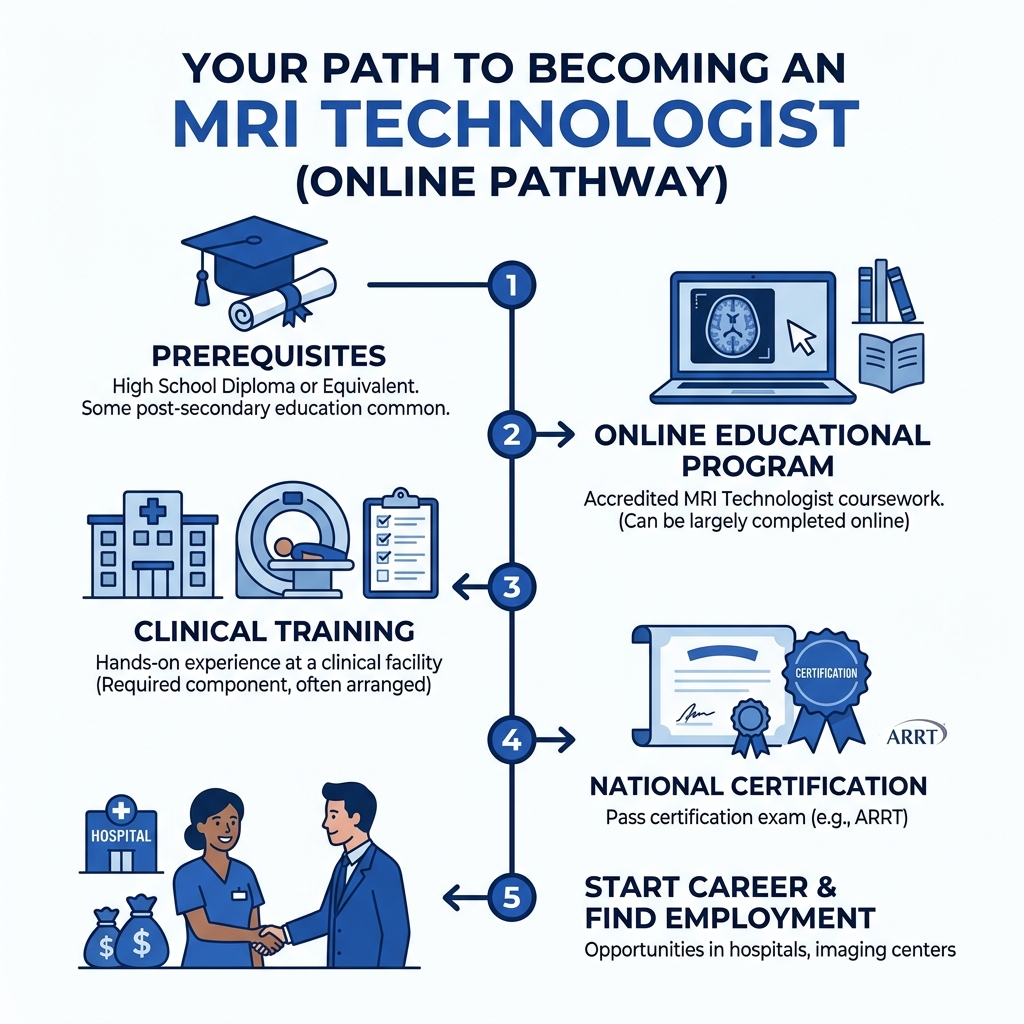
When we talk to students about starting a career in medical imaging, the first question is usually: “Where do I even start?” The answer depends on your current education level. In MRI, there are two main “pathways” recognized by the American Registry of Radiologic Technologists (ARRT).
The Primary Pathway is designed for those who don’t have a prior degree in imaging. If you are a high school graduate or switching careers from a non-medical field, this is your route. You’ll typically need to earn an associate degree (like an Associate of Applied Science in MRI Technology) that includes both the required classroom learning and clinical hours.
The Post-Primary Pathway is for those who are already certified in another area, such as Radiography (X-ray), Sonography, or Nuclear Medicine. These students can often complete shorter, 10-week to 9-month certificate programs to “add on” the MRI credential.
Regardless of the path, it is vital to choose Recognized Educational Programs – ARRT. This ensures your hard work actually counts toward your board exams.
To help you visualize the commitment, we’ve broken down the typical requirements for various entry level online mri options:
| Program Component | Short Certificate | Diploma Program | Associate Degree (AAS) |
|---|---|---|---|
| Typical Duration | 6–10 Months | 12–18 Months | 18–24 Months |
| Didactic (Theory) Hours | ~100–200 | ~600+ | ~800+ |
| Clinical Hours | ~500–600 | ~1,000+ | ~1,000+ |
| Average Cost | $1,800 – $5,000 | $15,000 – $30,000 | $30,000 – $40,000 |
Benefits of an Entry Level Online MRI Certificate
Why choose an online or hybrid format? For many of our students in cities like Detroit, Chicago, or Phoenix, life doesn’t stop just because they want a new career.
- Flexible Scheduling: Online lectures allow you to study when it suits you. Whether you’re a night owl or a morning person, you can engage with the material at your own pace.
- Live Interaction: Many programs offer live webinars. This isn’t just “reading a screen”; you can ask questions in real-time to instructors who are experts in the field.
- Career Switcher Friendly: If you are currently working a 9-to-5 job, a hybrid program allows you to keep your income while transitioning into healthcare.
- Accessible for Veterans: We find that veterans often excel in these programs because they appreciate the structured nature of the curriculum and the clear mission: pass the boards and get to work.
How Entry Level Online MRI Prepares You for the ARRT
The end goal of any entry level online mri program is the “Registry.” This is the national exam that proves you know your stuff. A high-quality program doesn’t just teach you how to push buttons; it prepares you for the ARRT®(MR) Examination requirements.
Preparation includes:
- Registry Review: Dedicated classes that simulate the 200-question ARRT exam.
- Structured Education: Meeting the mandatory 16 hours of structured education required by the ARRT (though most comprehensive programs provide far more).
- ARMRIT Prep: Some programs also qualify you for the American Registry of Magnetic Resonance Imaging Technologists (ARMRIT) exam, providing a dual-certification advantage.
Prerequisites and Physical Demands for MRI Students
Before you jump in, we need to talk about the “fine print.” MRI isn’t just an academic challenge; it has specific physical and safety requirements.
According to the MRI Technologist Job Description, you aren’t just sitting behind a computer. You are moving patients, setting up heavy equipment, and staying on your feet.
Standard Prerequisites & Requirements:
- Education: For the primary pathway, you need at least an associate degree. Many programs require a minimum GPA (often 2.5 to 2.8) in previous coursework.
- The “Magnet Rule”: This is non-negotiable. Because MRI uses powerful magnets, you cannot have certain internal implants (like pacemakers or certain metal shards) that could be dangerous in the scan room.
- Physical Strength: You must be able to lift at least 30 lbs. You’ll be helping patients move from wheelchairs to the MRI table, which requires physical stamina.
- Language & Background: Proficiency in English is required for patient safety and communication. You will also undergo a background check and must provide proof of immunizations before entering a clinical site.
Curriculum and Clinical Training Requirements
What exactly do you learn in an entry level online mri program? It’s a fascinating mix of hard science and compassionate patient care.
The core curriculum usually covers:
- MRI Physics: Understanding how magnetic fields and radio waves interact with atoms in the body. (Don’t worry, we make it easy to understand!)
- Sectional Anatomy: Learning to recognize organs and tissues from a cross-sectional perspective (top-down, side-view, etc.).
- Pulse Sequences: The “recipes” used to create different types of images.
- Patient Care & Safety: How to screen patients for metal and how to help those with claustrophobia feel at ease.
You can find More info about MRI technology programs on our website, but the “secret sauce” of any program is the Clinical Externship.
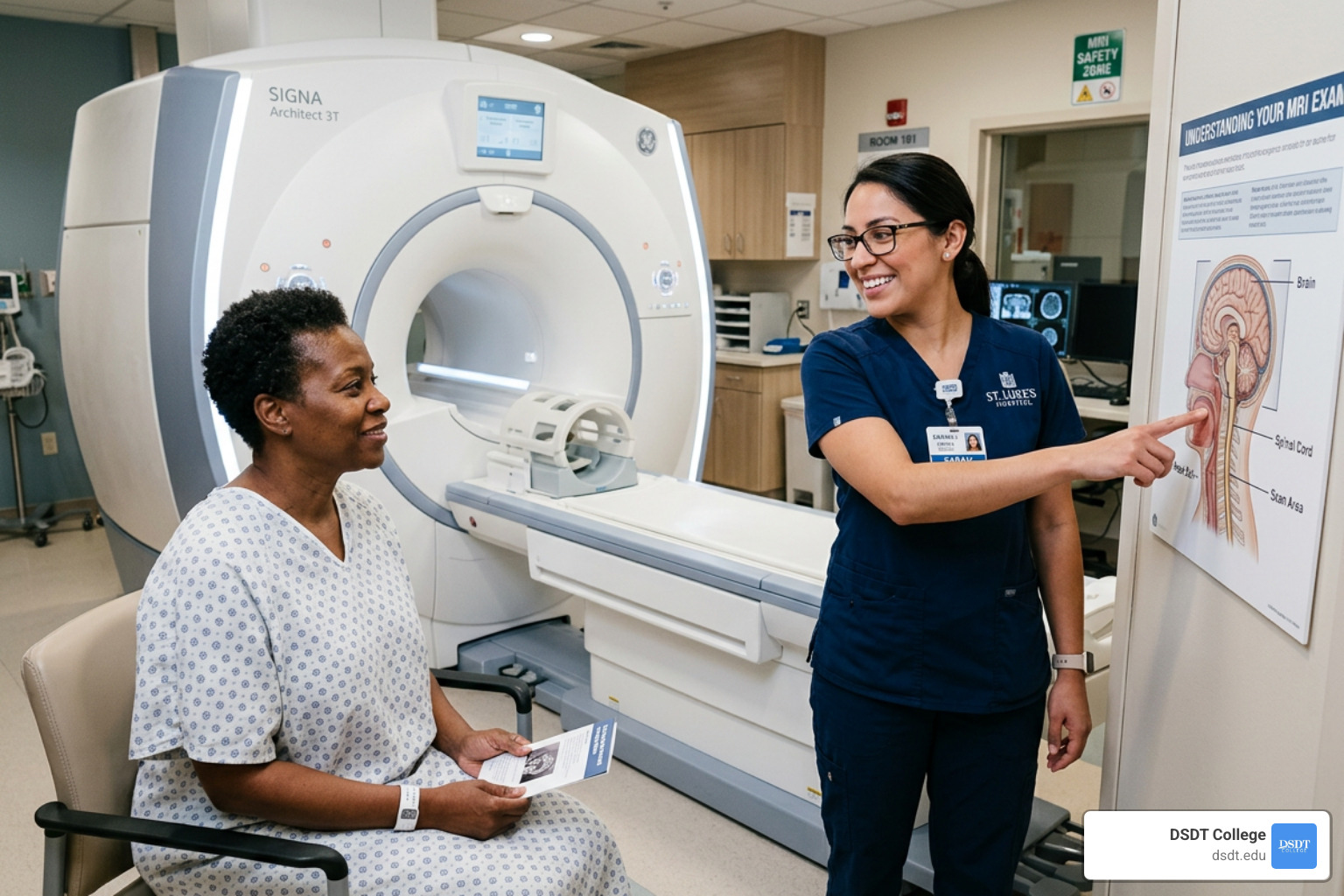
You cannot become an MRI tech entirely online. You must complete hundreds of hours (often between 500 and 1,000) in a real hospital or imaging center. Under the supervision of a clinical preceptor, you will perform “competencies”—specific scans of the brain, spine, and joints—to prove you can handle real-world cases. Most programs follow standards set by the Joint Review Commission on Education in Radiologic Technology (JRCERT) to ensure the training meets national quality benchmarks.
Career Outlook: Salary and Job Growth
If you’re looking for stability, you’ve found it. According to the Radiologic and MRI Technologists: Occupational Outlook Handbook, the median annual salary for MRI Technologists was $83,740 as of May 2023.
The job growth is equally impressive. While the national average growth is 7%, certain areas are booming. For example, Arizona is projected to see a 39% increase in demand for MRI technologists through 2030, and California is looking at a 12% increase.
In the Midwest—specifically around Detroit, Grand Rapids, and Chicago—we see a steady demand in both large hospital systems and outpatient imaging centers. As the population ages and doctors rely more on non-invasive imaging (which doesn’t use the radiation found in CT scans), the need for skilled operators only grows.
Frequently Asked Questions about Entry Level Online MRI
How long does it take to complete an online MRI program?
It depends on your starting point. If you are already an X-ray tech, you might finish a certificate in as little as 6 months. If you are starting from scratch, a comprehensive diploma or associate degree program typically takes 18 to 24 months. We often see students finish in about 72 weeks (18 months) when they follow a full-time schedule.
Can international students enroll in online MRI training?
Yes, but there are hurdles. You must meet English proficiency requirements and, most importantly, you must be able to attend clinical training at an approved site within the United States. Visa requirements apply if you are traveling for the clinical portion, so it’s best to speak with an admissions advisor early.
What is the difference between ARRT and ARMRIT certification?
Both are valid, but they have different focuses.
- ARRT (American Registry of Radiologic Technologists): The most widely recognized. Most hospitals require ARRT certification. It often requires an associate degree.
- ARMRIT (American Registry of Magnetic Resonance Imaging Technologists): Focuses exclusively on MRI. It is a great option for those who want to specialize immediately without necessarily becoming an X-ray tech first. You can learn more at ARMRIT MRI Programs.
Conclusion
Starting a career in medical imaging is a smart move for anyone looking for a “future-proof” job. Whether you are in Detroit, Michigan, or searching for a program from Virginia Beach to Seattle, the path to becoming an MRI technologist is clearer than ever.
At DSDT College, we specialize in helping students navigate this journey. From our home base in Detroit to our nationwide reach, we provide the tools you need to succeed. We offer flexible training, support for veterans, and a curriculum designed to get you into the workforce quickly.
Ready to take the next step? You can find More info about MRI technology programs and start your journey toward a rewarding career in healthcare today. We’re here to help you every step of the way!