What Is an MRI Technologist and How Do You Get Certified Through an ARRT Primary Pathway Program?
MRI Technologist, MRI college degree programs, ARRT primary pathway are three closely connected topics that matter most if you want to build a career in diagnostic medical imaging — starting from scratch.
Here is a quick answer to what most people want to know:
| Question | Quick Answer |
|---|---|
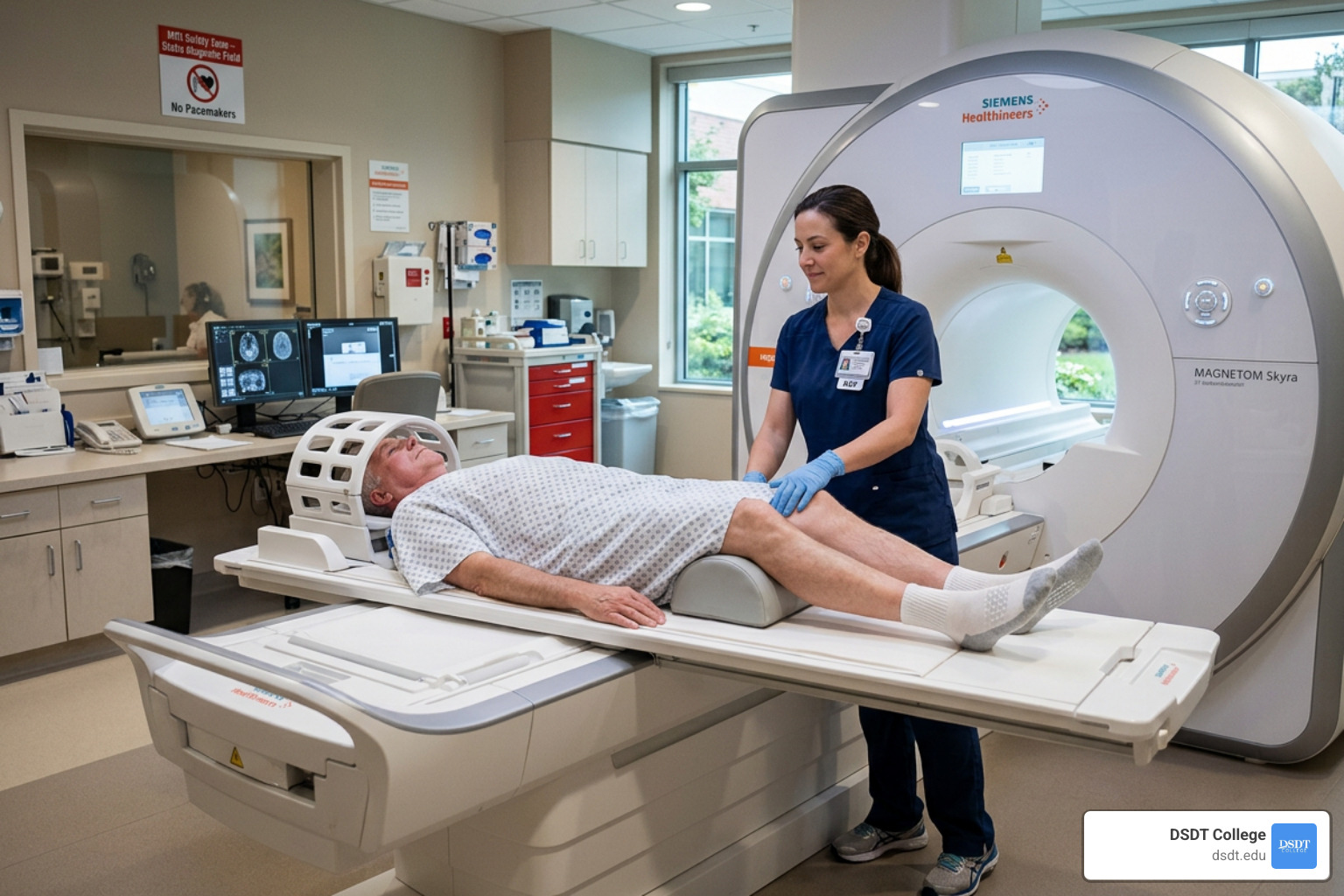
| What does an MRI Technologist do? | Uses magnetic fields and radio waves to create diagnostic images for physicians |
| What degree do you need? | At minimum, an associate’s degree from an ARRT-recognized accredited institution |
| What is the ARRT Primary Pathway? | The certification route for new entrants who complete an accredited MRI program |
| How long does it take? | Typically 18 months to 2+ years depending on the program |
| What does it pay? | Median earnings around $74,690, with a 13% job growth forecast |
The field is growing fast. The Bureau of Labor Statistics projects a 13% increase in MRI technologist jobs — well above average for most healthcare careers. With around 38,700 positions already in the workforce, demand for trained, certified technologists is only going up.
Getting there does require a clear plan. You need the right degree, an ARRT-approved program, hands-on clinical hours, and a passing score on the certification exam. This guide walks through exactly what that looks like — including real program options, costs, and what to expect along the way.
I’m Jamie Kothe, an academic leader and workforce development professional at DSDT College, where I work to align career-focused programs in allied health imaging with real industry needs and employer expectations. My work developing and supporting programs like the MRI Technologist, MRI college degree programs, ARRT primary pathway has given me a close look at what helps students actually succeed in this field — from first enrollment to first job.
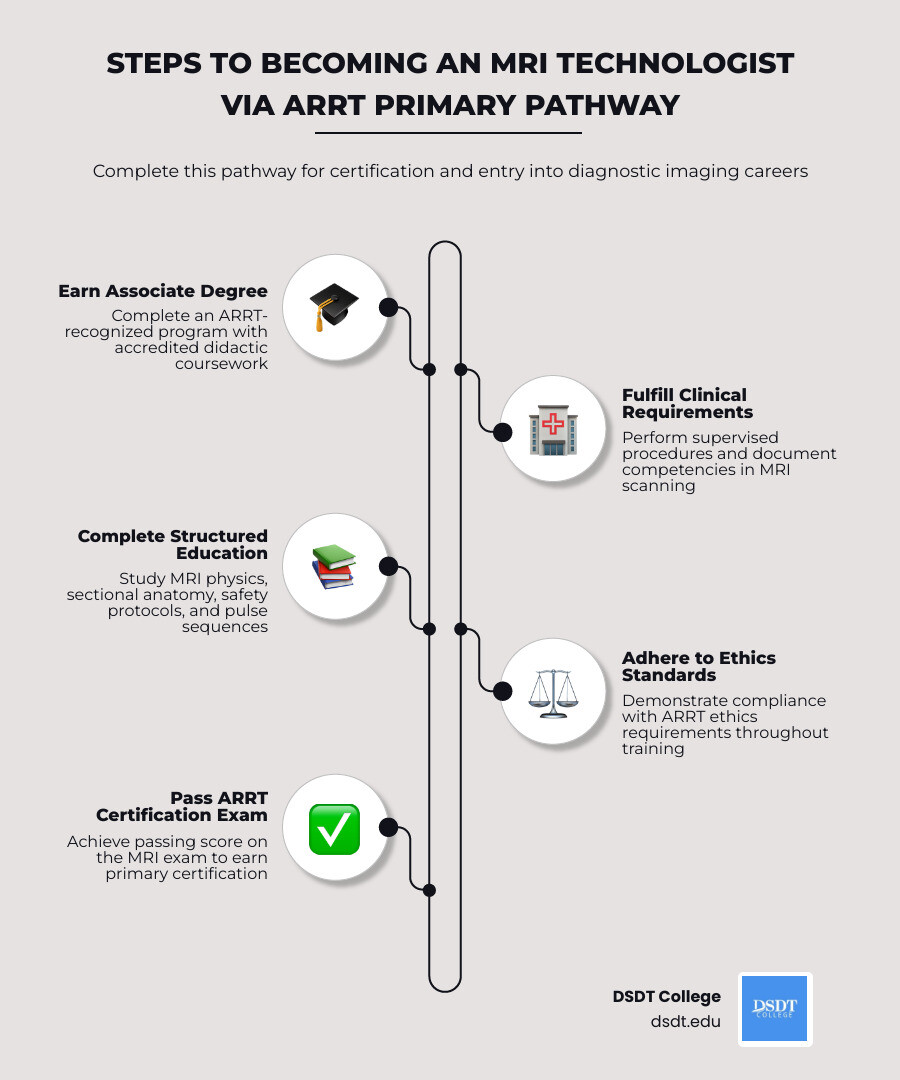
Navigating the MRI Technologist, MRI college degree programs, ARRT primary pathway
If you are looking to enter the medical imaging field, understanding the ARRT primary pathway is your first step. The American Registry of Radiologic Technologists (ARRT) is the leading credentialing body in the world for this profession. They set the “gold standard” for what a technologist should know and be able to do.

For most people starting their journey, the primary pathway is the most direct route. Unlike the “postprimary” route—which is designed for people who are already certified in something like X-ray or Ultrasound—the primary pathway allows you to go straight into MRI. To succeed here, you must navigate three main pillars: education, ethics, and examination.
You can find the full details of these requirements in the official Primary Handbook for ARRT Certification. It serves as the ultimate roadmap for your transition from student to professional.
Eligibility Requirements for the MRI Technologist, MRI college degree programs, ARRT primary pathway
To be eligible for the ARRT exam through the primary pathway, you don’t just need “any” training; you need a specific educational foundation.
- The Degree Requirement: You must earn an associate degree (or higher) from an institution accredited by an agency that the ARRT recognizes. Interestingly, your degree doesn’t technically have to be in radiologic sciences, though most students find that an Associate of Applied Science in MRI Technology provides the most relevant preparation.
- The Educational Program: You must complete an ARRT-approved educational program in MRI. This program ensures you’ve covered the necessary “didactic” (classroom) learning and “clinical” (hands-on) competencies.
- Clinical Competency: You can’t just read about MRI; you have to do it. You’ll need to demonstrate and document specific clinical procedures under supervision. These requirements are updated periodically to reflect modern medical standards. You can review the most current list here: Didactic and Clinical Competency Requirements.
Curriculum Standards for the MRI Technologist, MRI college degree programs, ARRT primary pathway
What exactly do you learn in these MRI college degree programs? It’s a fascinating mix of high-level physics, human anatomy, and patient psychology. Because MRI uses powerful magnets rather than radiation, safety is the number one priority.
A standard curriculum includes:
- Sectional Anatomy: Learning to identify organs and tissues from a “slice-by-slice” perspective.
- MRI Physics: Understanding how magnetic fields and radiofrequency pulses interact with atoms in the human body.
- Pulse Sequences: Mastering the technical settings that determine whether an image shows a bone fracture or a soft tissue tumor.
- Patient Management: Learning how to comfort patients who might feel claustrophobic inside the scanner.
- Safety Protocols: Managing the “zones” of an MRI suite to ensure no metal objects ever enter the magnetic field.
The ARRT provides a detailed breakdown of what will be on the certification exam, which helps schools like ours keep our curriculum sharp. You can check out the Examination Content Specifications to see the exact topics you’ll be tested on.
Comparing Associate, Bachelor, and Certificate Pathways
Choosing the right program format depends on your current background. If you are already a registered Radiologic Technologist (R.T.), a certificate might be enough. If you are starting fresh, an Associate of Applied Science (AAS) is usually the best bang for your buck.
| Program Type | Typical Duration | Best For | ARRT Pathway |
|---|---|---|---|
| Certificate | 6–12 Months | Current R.T.s (X-ray, etc.) | Postprimary |
| Associate Degree (AAS) | 18–24 Months | Career changers, High school grads | Primary |
| Bachelor’s Degree | 4 Years | Those seeking management roles | Primary |
The certificate route is often referred to as “structured education.” It’s a faster track for those who already have a medical imaging license. You can learn more about this specific route in the Postprimary Eligibility Pathway Handbook.
However, for the majority of our students in cities like Detroit, Chicago, or Dallas, the AAS degree is the preferred choice. It combines the necessary general education with specialized MRI training, making you eligible for the ARRT primary pathway exam upon graduation.
Key Educational Models and Program Features
Modern MRI training has evolved. We no longer expect students to sit in a dark classroom for eight hours a day. Many programs now use a hybrid model—online lectures for the theory and in-person clinical rotations for the practice.
Clinical Rotations and Observation
You cannot become an MRI Technologist without touching the equipment. Most programs require hundreds of hours of clinical experience. Before you even start, many top-tier programs require “observation hours.” For example, some university programs require at least 12 hours of watching a technologist work just to ensure you understand the daily realities of the job.
Prerequisites and Patient Care
Beyond the science, you need a heart for people. Many programs require you to have at least 80 hours of direct patient care experience (like being a CNA or Medical Assistant) before applying. You also must stay current with your Basic Life Support (BLS) Training through the American Heart Association.
Career Outlook: Salary and Job Growth for MRI Technologists
Is the investment worth it? The data says yes. According to 2017 statistics, MRI technologists earned an average salary of about $73,142. Today, that median has climbed to approximately $74,690, with top earners making significantly more through overtime and on-call shifts.
The job market is incredibly stable. The Bureau of Labor Statistics notes that as our population ages, the need for diagnostic imaging grows. Whether you are in Houston, Texas, or Newark, New Jersey, hospitals and private imaging centers are constantly looking for certified professionals. You can find more detailed state-by-state data in the Occupational Outlook Handbook for MRI Technologists.
Frequently Asked Questions about MRI Programs
What is the difference between the ARRT Primary and Postprimary pathways?
The Primary Pathway is for students who are new to medical imaging. They complete a full degree program specifically for MRI. The Postprimary Pathway is for people who are already certified in another area (like Radiography or Sonography) and want to add MRI to their existing credentials.
How long does it take to complete an MRI Associate degree program?
Most Associate of Applied Science programs, like the one we offer, take about 18 to 24 months. This includes your general education requirements, your MRI-specific classes, and your clinical rotations.
Can I complete my MRI technologist training online?
Yes and no. You can complete the “didactic” or classroom portion online (physics, anatomy, etc.). However, you must complete your clinical hours in person at a hospital or imaging center. There is no such thing as a 100% online MRI program that leads to certification because you need hands-on experience with the scanner.
Conclusion
Becoming an MRI Technologist is a rewarding journey that blends cutting-edge technology with essential patient care. By choosing the right MRI college degree programs and following the ARRT primary pathway, you are setting yourself up for a stable, high-paying career in a field that truly helps people.
At DSDT College, we are committed to helping our students in Michigan, Ohio, Florida, and across the country reach these goals. Our Associate of Applied Science in MRI Technology is designed to get you from the classroom to the clinic with confidence.
Ready to take the next step? Find more info about MRI Technology Associate Degree and see how we can help you start your new career today.