

What Are Pen Testing Courses — and Which One Is Right for You?
Pen testing courses are structured training programs that teach you how to legally simulate cyberattacks, find security weaknesses, and help organizations fix them before real attackers strike.
Here are the most popular certification paths at a glance:
| Certification | Best For | Focus Area | Time Commitment |
|---|---|---|---|
| CompTIA Security+ | Beginners | Security Fundamentals | Self-paced |
| CompTIA PenTest+ | Entry-level professionals | Penetration Testing | Self-paced |
| CompTIA CySA+ | Intermediate professionals | Security Analytics | Self-paced |
| Advanced Practical Certs | Advanced practitioners | Hands-on Exploitation | 200+ hours |
The demand for penetration testers is real. According to Indeed, the average penetration tester earns $119,281 per year. The field is growing fast, and so is the gap between professionals who have hands-on skills and those who don’t.
Whether you’re a veteran transitioning into cybersecurity, an active-duty soldier preparing for civilian life, or simply someone who wants to break into ethical hacking, choosing the right course matters. The wrong choice can cost you thousands of dollars and months of time.
I’m writing on behalf of DSDT College — a nationally accredited, Military-Friendly institution with a focused track record in CompTIA-aligned pen testing courses and cybersecurity certifications, including PenTest+, CySA+, and Security+. In the sections below, I’ll walk you through every major training path so you can make a confident, informed decision.
The Evolution of Modern Pen Testing Courses
The landscape of cybersecurity education has shifted dramatically over the last decade. Gone are the days when you could learn everything from a textbook. Modern pen testing courses are now built around a hands-on, grit-focused approach that mimics the actual pressure of a live security breach.
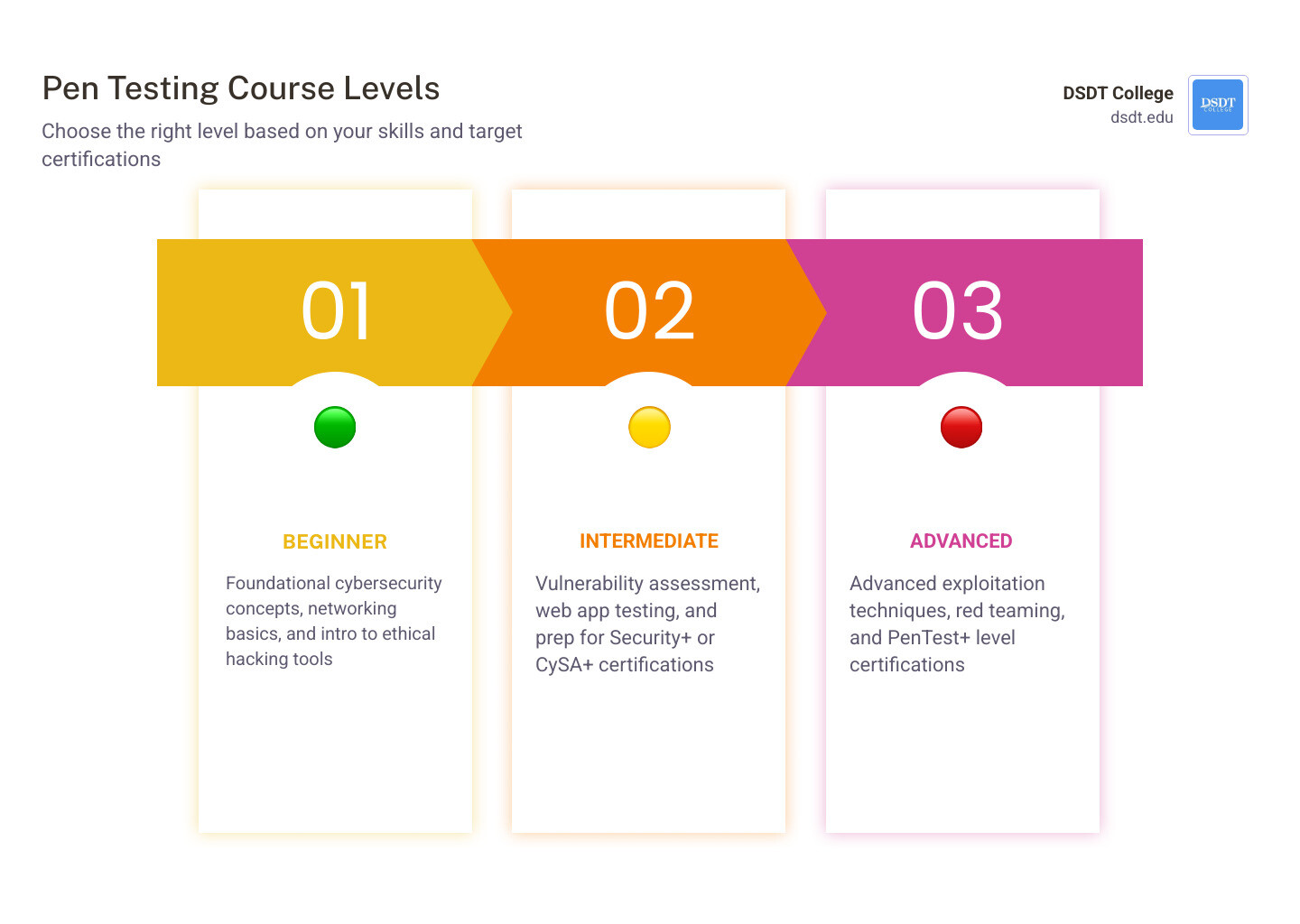
Today, choosing a course starts with a skill level assessment. Are you a beginner who needs to understand how a network functions, or an intermediate professional looking to master Active Directory exploitation? The industry has responded with a variety of delivery methods:
- Self-Paced Learning: Modular content that fits into a busy schedule, often delivered through digital platforms.
- Intensive Bootcamps: High-impact training sessions designed to deliver a large volume of information in a short window.
- Comprehensive Academic Tracks: Institutions like ours offer structured, accredited environments that provide 200+ hours of content over several months, ensuring you don’t just learn a tool, but a methodology.
Most high-quality pen testing courses are now mapped to the NICE (National Initiative for Cybersecurity Education) framework. This ensures that the skills you learn—from Open-Source Intelligence (OSINT) to professional report writing—match exactly what employers are looking for in the real world.

Entry-Level Pen Testing Courses and Certifications
If you are just starting out, you cannot jump straight into advanced exploitation. You need a foundation in Linux basics, networking essentials (TCP/IP, DNS, and DHCP), and basic scripting in languages like Python or PowerShell.
For many, the first major milestone is the CompTIA PenTest+. This certification is unique because it covers both the technical aspects of hacking and the management side of a “pen test,” such as scoping the engagement and legal compliance. It is widely considered the gold standard for those entering the field because it balances theory with practical application.
At DSDT College, we emphasize these foundational skills through our Information Technology Associate Degree, which prepares students for the rigors of the cybersecurity workforce with a broad, accredited base of knowledge.
Advanced Pen Testing Courses for Specialized Roles
Once the basics are mastered, the path branches into specialized domains. Advanced pen testing courses focus on complex environments like:
- Active Directory (AD) Attacks: Learning to move laterally through a Windows domain using Kerberoasting or BloodHound.
- Cloud Security: Exploiting misconfigurations in modern cloud environments.
- Binary Exploitation: Reverse engineering software to find “zero-day” vulnerabilities.
Advanced certifications are highly respected here, offering 100% practical exams that challenge you to perform in a live cyber range that evolves as you attack it.
Essential Skills Taught in Professional Programs
A professional penetration tester is more than just a “hacker.” They are security consultants who follow a strict methodology. When you enroll in top-tier pen testing courses, you will master a specific set of technical and soft skills.
- OSINT Techniques: Gathering intelligence from public sources before ever touching the target network.
- Social Engineering: Testing the “human firewall” through phishing simulations.
- Web Application & API Security: Using industry-standard tools to find vulnerabilities in the apps that power the modern web.
- Privilege Escalation: Turning a low-level user account into a “Domain Admin” or “Root” user.
- Evasion & Persistence: Learning how to bypass EDR (Endpoint Detection and Response) and AV (Antivirus) systems to stay hidden in a network.
Technical Skills Comparison by Certification Level
| Skill Area | Entry Level (Security+) | Intermediate (PenTest+) | Advanced (Practical Certs) |
|---|---|---|---|
| Networking | Basic Ports & Protocols | Scanning & Enumeration | Pivoting & Tunneling |
| Web Apps | Security Concepts | OWASP Top 10 Basics | API Exploitation |
| Windows | Basic Permissions | User Enumeration | Active Directory Attacks |
| Reporting | Documentation Basics | Vulnerability Lists | Full Remediation Plans |
Evaluating Costs and Time Commitments
The investment required for pen testing courses varies wildly based on the depth of the material and the prestige of the certification.
- The Starting Point: You can find introductory material and foundational content through various free or low-cost online resources to get a feel for the field.
- The Professional Standard: Mid-range professional certification programs typically start around $1,500 to $1,800, which often includes lab access and an exam voucher.
- The Intensive Option: Premium enterprise-level courses can cost upwards of $8,000. While expensive, these are often targeted at corporate teams and offer high-impact training over a short duration.
- The Comprehensive Track: Accredited programs designed for long-term mastery often run around $3,000. These ensure you absorb 200+ hours of content over several months.
When evaluating cost, always check if the exam voucher is included. Some courses require you to pay an additional $400–$900 just to take the test at the end.
Career Benefits and Job Roles for Certified Professionals
The primary reason to pursue pen testing courses is the career transformation. With an average salary of $119,281, penetration testing is one of the most lucrative paths in IT.
Common job roles include:
- Penetration Tester: Simulating attacks to identify weaknesses.
- Security Analyst: Monitoring and defending networks based on threat intelligence.
- Vulnerability Assessment Analyst: Identifying and prioritizing risks within an organization.
- Red Team Operator: Conducting long-term, “stealth” simulations to test an organization’s detection capabilities.
Military and Veteran Career Paths
At DSDT College, we take immense pride in being a Military-Friendly institution. We understand the unique needs of the military community. Our programs are designed for:
- Veterans: Use your Post-9/11 GI Bill® to transition into a high-paying tech career.
- Active-Duty Soldiers: Utilize Tuition Assistance (TA) to gain certifications before you transition.
- Spouses: Take advantage of MyCAA funding for rapid, mobile-friendly career training.
We offer accelerated paths with no waitlists and no SAT/ACT requirements. Whether you are looking for 100% online flexibility that moves with your PCS or you want to participate in our in-person Cybersecurity CSP/SkillBridge program at Fort Hood, we provide the structure you need to succeed.
Frequently Asked Questions about Penetration Testing
What are the prerequisites for advanced penetration testing certifications?
Most advanced pen testing courses expect you to have a solid grasp of Linux command-line usage, networking protocols, and at least one scripting language like Python. Many students find it helpful to earn their Security+ or PenTest+ first to build a strong foundation.
How do hands-on labs and CTFs improve learning outcomes?
In cybersecurity, “knowing” is not the same as “doing.” Hands-on labs allow you to practice attacks in a safe, legal environment. Capture the Flag (CTF) challenges add a layer of gamification and pressure, forcing you to think creatively and persist when a standard exploit fails. This builds the “adversarial mindset” required for the job.
What is the difference between a 24-hour proctored exam and a traditional format?
Traditional exams are often multiple-choice and taken in 2–3 hours. A 24-hour proctored exam is a grueling practical test. You are given access to a private network and must successfully compromise a certain number of machines and write a professional report within the time limit. It is a test of both technical skill and mental endurance.
Conclusion
Choosing the right pen testing courses is the first step toward a rewarding, high-impact career in cybersecurity. Whether you are looking for the flexibility of online learning or the structure of an in-person intensive, the goal remains the same: mastering the skills to protect the digital world.
DSDT College is committed to providing career-focused, nationally accredited education. From our Fort Hood Cybersecurity CSP in-person training to our nationwide online programs for military families, we offer accelerated paths to get you into the workforce faster.
Don’t wait for a waitlist. Start your journey into ethical hacking today.