Why Demand for Cybersecurity Degree, AI and IT Degree Programs and Hands On Labs, Online Learning Nationwide Has Never Been Higher
If you’re comparing cybersecurity degree, AI and IT degree programs and hands on labs, online learning nationwide, here are the most important things to know right now:
| Program Type | Example Institutions | Avg. Cost/Credit | Key Feature |
|---|---|---|---|
| BS in Cybersecurity (Online) | Accredited Online Universities | $268–$485 | NSA-designated, transfer-friendly |
| MS in Cybersecurity/AI (Online) | National Tech Colleges | $336–$775 | CISSP/CEH prep, virtual labs |
| AI + Cybersecurity (Online) | Leading Research Institutions | $735–$775 | Machine learning, threat modeling |
| Accelerated Certification Path | DSDT College | Flat-rate/term | CompTIA stack, no SAT/ACT |
| Bootcamp (Fast-Track) | Industry Bootcamps | $8,995–$10,995 | Security+, 25+ tools, 13–21 weeks |
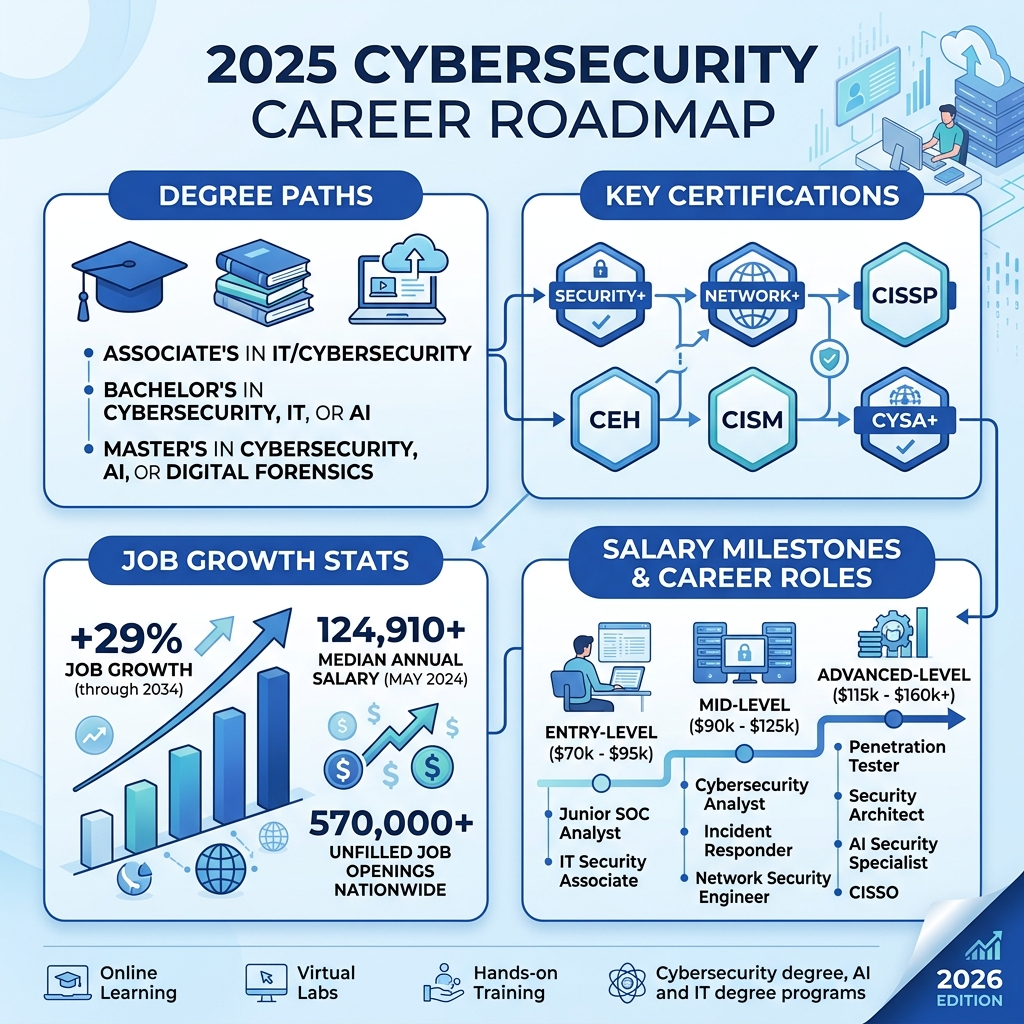
The numbers behind this field are hard to ignore. Information security analyst jobs are projected to grow 29% through 2034 — far faster than almost any other occupation. The median annual salary hit $124,910 as of May 2024. And right now, there are more than 570,000 unfilled cybersecurity job openings across the United States.
That gap between supply and demand is exactly why so many accredited colleges now offer fully online pathways — with virtual labs, hands-on simulations, and real-world tools built right into the curriculum.
The good news: you don’t need to relocate, quit your job, or pay Ivy League prices to get started.
We are writing on behalf of DSDT College — a nationally accredited, military-friendly institution serving career changers and veterans nationwide through cybersecurity degree, AI and IT degree programs and hands on labs, online learning nationwide. At DSDT, we specialize in CompTIA-aligned cybersecurity training, Full Stack Development, Machine Learning, and AI Prompt Engineering — built for people who need a direct, accredited path to a high-demand career without the four-year wait.
Top Online Cybersecurity Degree, AI and IT Degree Programs and Hands On Labs, Online Learning Nationwide
Finding the right cybersecurity degree, AI and IT degree programs and hands on labs, online learning nationwide requires looking beyond just the tuition price. You need a program that balances theory with the “how-to” of digital defense.
Many top-tier universities have moved their entire curriculum online to reach students from Miami to Seattle. For instance, high-quality online BS in Cybersecurity programs focus on a “security mindset,” combining systems thinking with adversarial thinking. Similarly, interdisciplinary approaches provide a blend of technical knowledge with philosophy and criminal justice.
A major differentiator for high-quality programs is the National Center of Academic Excellence in Cyber Defense (NCAE-CD) designation. This recognition from the NSA and DHS ensures the curriculum meets rigorous federal standards. Schools holding these designations give their graduates a significant edge in the federal and private job markets.
At DSDT College, we take a different approach by focusing on IT specialist training that gets you into the workforce faster. Our programs are designed to be mobile-friendly and accessible nationwide, ensuring that whether you are in Detroit or San Diego, you have access to industry-aligned training.
How a Cybersecurity Degree, AI and IT Degree Programs and Hands On Labs, Online Learning Nationwide Prepare You for the Workforce
The most common question we hear is: “Can I actually learn to hack or defend a network through a computer screen?” The answer is a resounding yes, thanks to advanced hands-on labs.
Modern online programs use virtual security labs to simulate real-world environments. Advanced AI-driven learning environments allow students to practice:
- Malware Analysis: Safely dissecting viruses to understand their code.
- Ethical Hacking: Using tools like Kali Linux to find vulnerabilities before the “bad guys” do.
- Incident Management: Responding to simulated data breaches in real-time.
These labs are designed to prepare you for Certified Ethical Hacker (CEH) prep and other high-level certifications. By the time you graduate, you aren’t just holding a piece of paper; you have a portfolio of completed lab scenarios that prove you can do the job.

Comparing a Cybersecurity Degree, AI and IT Degree Programs and Hands On Labs, Online Learning Nationwide to Traditional Formats
Traditional four-year degrees often struggle to keep up with the pace of technology. In contrast, online cybersecurity degree, AI and IT degree programs and hands on labs, online learning nationwide are built for agility.
- Asynchronous Learning: You don’t have to log in at 9:00 AM. You can study after work or while the kids are asleep.
- Accelerated Terms: Many schools, including DSDT College, offer 8-week terms, allowing you to finish your degree much faster than a traditional semester-based school.
- Competency-Based Models: Modern institutions allow you to “prove what you know.” If you already have IT experience, you can pass assessments and move on to the next subject immediately.
- Generous Transfer Policies: Most of the accredited schools we’ve researched allow you to transfer up to 90 credits. This can turn a four-year degree into a one-year sprint.
To simplify the process, many students use Common App resources to apply to multiple institutions at once, though specialized colleges like ours often have a faster, direct application process with no SAT or ACT requirements.
Career Outlook: Salaries and Growth in Cyber and AI
If you are looking for stability and high earnings, you’ve found the right field. According to the Bureau of Labor Statistics Data, the demand for information security analysts is expected to surge by 33% through 2033.
But it’s not just about the number of jobs; it’s about the pay. The median annual wage for these professionals is over $120,000. In certain tech hubs like Washington, DC, or San Francisco, those numbers can climb even higher.
| Job Title | Median Salary (May 2024) | Projected Growth |
|---|---|---|
| Information Security Analyst | $124,910 | 33% |
| Computer & Information Research Scientist | $140,910 | 26% |
| IT Manager / Systems Manager | $169,020 | 15% |
| Network Engineer | $102,730 | 5% |
The CyberSeek Supply/Demand Heat Map currently shows a massive shortage of qualified workers. With over 570,000 openings, companies are no longer just looking for “the perfect candidate”—they are looking for anyone with the right certifications and a solid educational foundation.
High-Demand Roles for Graduates
A cybersecurity degree, AI and IT degree programs and hands on labs, online learning nationwide can open doors to various specialized roles:
- Penetration Tester: Also known as a “White Hat” hacker, you are paid to break into systems to find flaws.
- Security Engineer: You build the walls and defense systems that keep hackers out.
- Malware Analyst: You study the “DNA” of cyber threats to prevent future attacks.
- Digital Forensic Examiner: You work with law enforcement or private firms to recover data from hacked devices.
Many of these roles require CISSP Certification Prep as you move into management, which is a core focus of master’s level programs at leading accredited institutions.
Industry Certifications and Earning Potential
While a degree provides the foundation, certifications provide the “stamp of approval” from the industry. At DSDT College, our Business Information Technology Specialist Program is specifically built to help you earn the “CompTIA Stack.”
- CompTIA A+: The starting point for any IT career.
- Network+: Proves you understand how data moves.
- Security+: The global standard for foundational cybersecurity skills.
- CySA+ (Cybersecurity Analyst): Focuses on behavioral analytics to improve network security.
- PenTest+: For those who want to specialize in offensive security.
Earning these certifications can lead to an immediate jump in salary. Graduates of certification-heavy programs report earning significantly more per year just two years after finishing their training.
Specialized Pathways: From AI Prompt Engineering to Cyber Operations
The landscape of IT is shifting. It’s no longer enough to just know how to secure a server; you now need to know how to secure an AI. Emerging cybersecurity degree, AI and IT degree programs and hands on labs, online learning nationwide are now integrating Generative AI into their core curriculum.
The Official 2023 Cybercrime Report highlights that cybercrime damages will reach $10.5 trillion annually by 2025. This massive threat level is driving the need for specialists in Cloud Computing, Data Analytics, and Project Management.
Integrating Emerging Technologies
We believe that AI literacy is the new “required skill” for the 21st century. Programs like our AI Prompt Engineering training teach you how to use AI as a force multiplier. Instead of manually checking thousands of lines of code for errors, you can prompt an AI to do it in seconds.
Top master’s programs offer specializations in “AI for Cyber” and “Cyber for AI.” This includes:
- Machine Learning: Building systems that learn to detect threats automatically.
- Secure Coding: Using Python and C to create software that is resistant to AI-driven attacks.
- Automated Security: Implementing “bots” that monitor networks 24/7.
Healthcare IT and MRI Technology Pathways
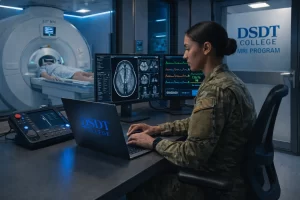
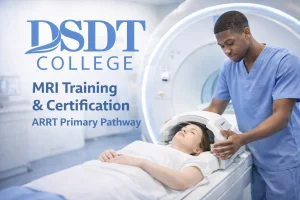
Not every high-tech career involves sitting behind a firewall. Healthcare is one of the largest employers of IT and imaging professionals. We offer an Associate of Applied Science in MRI Technology that serves as a direct ARRT Primary Pathway.
Unlike other programs that require you to be an X-ray tech first, our program allows you to go directly into MRI. This is a 100% online program for the classroom portion, making it a flexible and comprehensive alternative for those seeking direct entry into the field. We partner with clinical sites and hospitals nationwide to ensure our students get the required hands-on externship hours in their local area. This is a perfect path for someone who wants to combine technology with patient care.
Military and Veteran Support for Online Tech Degrees
We take immense pride in being a military-friendly school. Whether you are a veteran using the Post-9/11 GI Bill®, an active-duty soldier using Tuition Assistance, or a spouse utilizing MyCAA, cybersecurity degree, AI and IT degree programs and hands on labs, online learning nationwide are designed to move with you.
Our military benefits team is expert at navigating the paperwork so you don’t have to. We understand that military life is unpredictable, which is why our online programs have no waitlists and offer accelerated paths to graduation.
Flexibility for Active-Duty Families
For military spouses and active-duty members, the biggest hurdle is often the “PCS” (Permanent Change of Station). Our online programs are fully portable. You can start your IT specialist training in Fort Bragg and finish it in Germany.
- No SAT/ACT required: We value your experience over standardized tests.
- Credit for Experience: Many schools, including DSDT, offer college credit for your military training (JST).
In-Person Cybersecurity CSP at Fort Hood
For those currently stationed at or near Fort Hood, we offer a specialized, in-person Cybersecurity Career Skills Program (CSP/SkillBridge). This is an intensive, face-to-face program designed to transition service members directly into high-paying civilian cyber roles.
Note: While our degree and certificate programs are available online, the Fort Hood CSP is strictly in-person to provide the level of mentorship required for rapid career transition.
Frequently Asked Questions about Cybersecurity Degrees
Is a bachelor’s in cybersecurity worth it?
Absolutely. With a median salary of over $124,000 and 33% job growth, the return on investment (ROI) is among the highest of any degree. Furthermore, 45% of cybersecurity job postings specifically require a bachelor’s degree.
How long does it take to get a cybersecurity degree online?
It varies. A traditional bachelor’s takes 4 years, but with transfer credits and accelerated 8-week terms, many students at career-focused colleges like DSDT finish in 18 to 30 months.
Do I need a computer science background for an AI degree?
Not necessarily. Many programs, including our AI Prompt Engineering and IT Specialist tracks, are designed for beginners. If you are comfortable using a computer and have a curious mindset, you can succeed.
Conclusion
The digital world is expanding, and so is the need for people who can protect it. Whether you are interested in a cybersecurity degree, AI and IT degree programs and hands on labs, online learning nationwide, or you want to pivot into healthcare through MRI technology, the path forward is clearer than ever.
At DSDT College, we are committed to providing nationally accredited, career-focused education that fits your life. From our Detroit roots to our nationwide online community, we provide the tools, certifications, and support you need to thrive in the modern economy.
Ready to start your mission? Explore our Business Information Technology Specialist Program today and take the first step toward a secure future.