
Cybersecurity Analyst Bootcamps That Actually Get You Hired
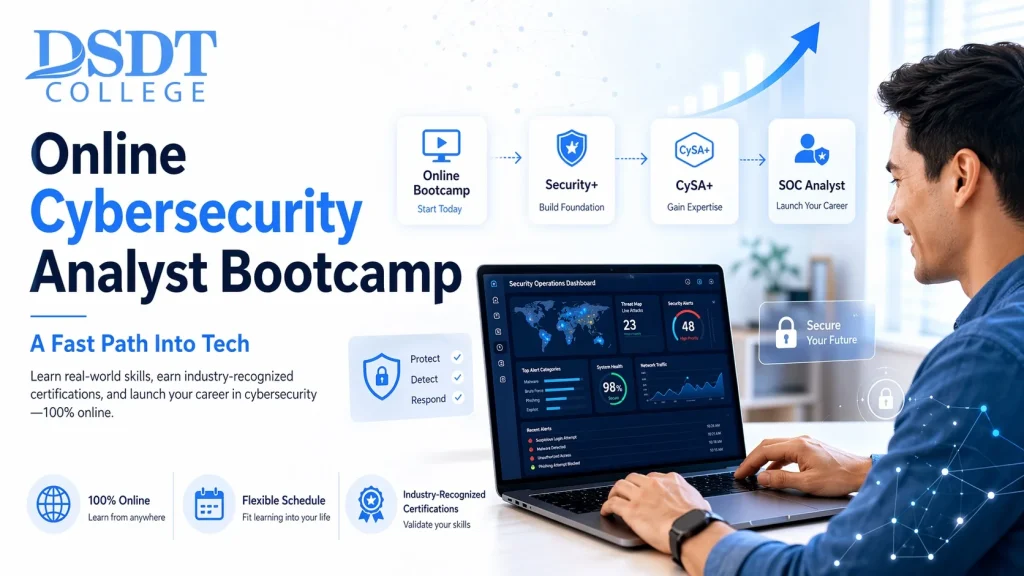
Launch your cybersecurity career with our online cybersecurity analyst bootcamp. Gain skills, certifications, and job support for high-paying SOC roles.
Which Cybersecurity Analyst Certification Actually Gets You Hired?
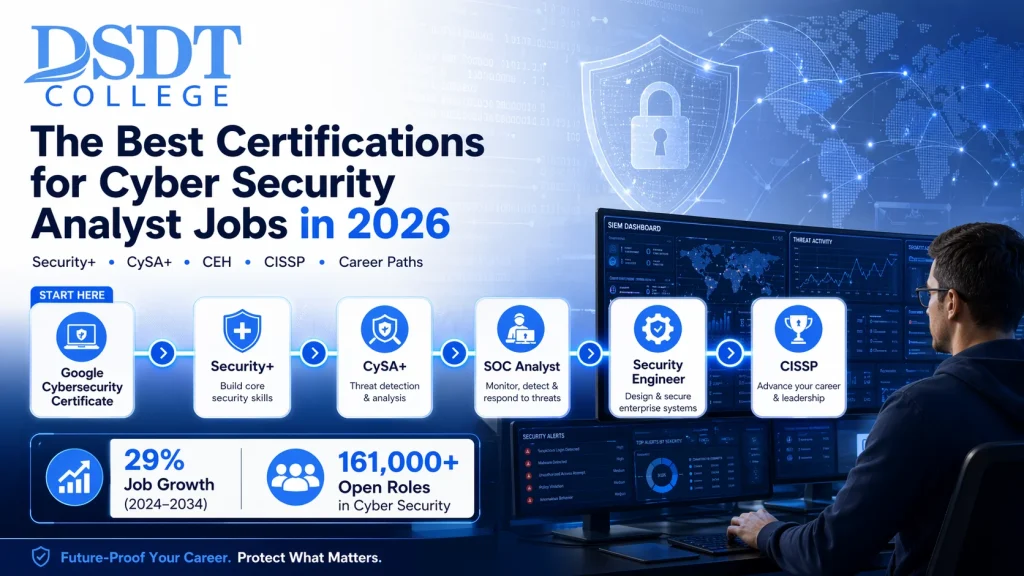
Discover the best certifications for cyber security analyst roles in 2026: CySA+, Security+, CEH & more. Get hired fast with job stats, costs & career paths!
Best Security Plus Training: From Zero to Cyber Hero
Why the Best CompTIA Security+ Course Can Launch Your Cyber Career The best CompTIA Security+ course gives you a structured, proven path to one of the most recognized certifications in cybersecurity — without wasting time or money on the wrong resources. Here are the top Security+ (SY0-701) training formats to consider: Training Format Best For Key Benefit Cost Accelerated In-Person (DSDT) Active-duty & Veterans Hands-on, immersive TA/GI Bill® eligible Structured Online (DSDT) Career changers Flexibility & support Competitive Self-Paced Video Independent learners Low cost Varies Practice Simulations Exam readiness Realistic PBQ practice Varies CompTIA Security+ (SY0-701) is the most widely recognized entry-level cybersecurity certification in the world. It launched on November 7, 2023, and is approved for 11+ DoD 8140 work roles — meaning it can directly qualify you for government and military cybersecurity positions. The exam has a maximum of 90 questions, runs 90 minutes, and requires a passing score of 750 out of 900. It covers five domains: Whether you’re a veteran using your Post-9/11 GI Bill®, an active-duty soldier prepping for civilian life, or a career changer breaking into tech — choosing the right course is the single biggest factor in passing on your first try. I’m an expert from DSDT College, a nationally accredited Military-Friendly institution specializing in CompTIA-based cybersecurity training — and helping students find the best CompTIA Security+ course for their goals is exactly what we do. Read on for a clear-eyed comparison of your top options. Why DSDT’s Accelerated Security+ Program is Your Best Choice When you are looking for the best CompTIA Security+ course, the “best” often depends on your learning style and career goals. At DSDT College, we specialize in serving those who need more than just a playlist of videos. We cater to career changers, high school graduates, and military personnel who thrive in structured, high-intensity environments. For our active-duty service members, we offer a unique advantage: the Cybersecurity CSP/SkillBridge program. Unlike many generic online options, this is a strictly in-person, immersive experience held at Fort Hood. This face-to-face interaction allows for immediate feedback and deep dives into complex topics that are often glossed over in self-paced courses. We understand that breaking into this field can feel daunting. Many First-Year BTech Students Seeking Advice on Cyber Security Career wonder if they have what it takes. Our expert-led instruction is designed to take you from zero to hero by focusing on hands-on experience. We don’t just want you to memorize definitions; we want you to understand how to defend a network in real-time. Comprehensive Training and Study Resources Leveraging Expert-Led Practice and Simulations Passing the SY0-701 exam requires more than just reading a textbook. The most successful candidates use a combination of expert-led lectures and rigorous practice. High-quality professional courses are popular for a reason. These programs are valued because they offer: Foundational Resources and Community Support If you are on a budget, there are numerous free video resources available online that cover every single exam objective. These are incredible for building a foundational understanding of the material. However, many students find that free, self-paced resources lack the “human” element. That is where DSDT College steps in. We provide a structured curriculum where you aren’t just a number in a subscriber count. You have access to dedicated instructor support and a community of peers who are on the same journey. Whether you are studying online from Detroit or attending our in-person sessions at Fort Hood, having a support system is often the difference between giving up and crossing the finish line. Mastering the SY0-701 Exam: Domains and Strategy To conquer the Security+ exam, you need a battle plan. The SY0-701 version is updated to reflect the modern landscape, including trends like Zero Trust, cloud security, and automation. Here is how the scoring breaks down: Successful candidates recommend a “domain-first” strategy. Don’t just study randomly; focus on the weights. Since Security Operations makes up 28% of the exam, you should spend a significant portion of your time mastering incident response, digital forensics, and monitoring tools. We suggest a 30-day intensive study plan. Week one should focus on General Security Concepts and Threats. Week two shifts to Architecture. Week three covers Operations and Program Management. Finally, week four should be dedicated entirely to practice exams and PBQ simulations. Hands-On Labs and Performance-Based Questions (PBQs) The PBQs are often what scare students the most. These questions drop you into a simulated environment—like a virtual terminal or a firewall configuration screen—and ask you to solve a problem. You might have to set up a secure wireless network or identify the source of a malware infection using log data. To prepare for these, you need hands-on labs. The best CompTIA Security+ course options will include lab environments where you can practice: At DSDT College, our in-person training at Fort Hood emphasizes these practical skills. We believe that if you can do the job in a lab, you can pass the question on the exam. Career Paths and Military Benefits for Security+ Candidates One of the primary reasons to seek out the best CompTIA Security+ course is the career door it opens. Because Security+ is DoD 8140 compliant, it is a mandatory requirement for many IT roles within the Department of Defense. This includes positions like: For our military community, the financial barriers to entry are significantly lowered. DSDT College is a military-friendly school, meaning we are experts in navigating the Post-9/11 GI Bill® and MyCAA for spouses. We also offer More info about the in-person Cybersecurity CSP at Fort Hood for active-duty soldiers looking for an accelerated path into a civilian career. Career changers also benefit from the vendor-neutral nature of the Security+. Unlike certifications that focus on just one brand of software, Security+ proves you understand the underlying principles of security that apply to any organization, from a small startup to a global hospital network. Frequently Asked Questions about Security+ Training How long does it typically take to pass the Security+ exam? While it
Which Best Platform to Learn Cyber Security Actually Works

Discover the best platform to learn cyber security with hands-on labs, certifications & DSDT College’s career-focused training for beginners to pros.
The Complete List of Cybersecurity Degrees Nationwide

Discover cybersecurity degree, AI and IT degree programs and hands on labs, online learning nationwide. Launch your cyber career with hands-on labs and top certifications!
Are You Looking for Cybersecurity Certificate or Courses in Detroit?

In today’s digital age, cybersecurity is not just a tech buzzword—it’s a frontline defense against data breaches, ransomware, phishing, and cyber threats that cost companies billions annually. As industries digitize and cloud technologies proliferate, so too does the demand for skilled professionals who can protect sensitive information and secure digital infrastructure. So, if you’re asking: Are you looking for a cybersecurity certificate or courses in Detroit? The answer is here—and it’s more promising than ever. This comprehensive guide will walk you through: Let’s dive in. 🔐 Why Cybersecurity Matters More Than Ever Before we explore courses and certifications, it’s important to understand why cybersecurity is one of the most important industries of the 21st century. The Threat Landscape In 2025, data is more valuable than oil. With millions of users online and businesses operating in the cloud, cyberattacks are on the rise. Major corporations, hospitals, banks, and even school districts in Michigan have been targets of data theft, ransomware, and denial-of-service attacks. According to Cybersecurity Ventures: The Detroit Context The city of Detroit is transforming into a hub for tech and innovation. With new digital infrastructure, smart city initiatives, and automation across manufacturing, healthcare, and government sectors—cybersecurity has become a local necessity. That means trained professionals are needed in: If you’re looking to upskill, reskill, or break into tech—now is the perfect time to explore cybersecurity training courses in Detroit. 🧠 What Is a Cybersecurity Certificate? A cybersecurity certificate is a credential earned through short-term, career-focused training that prepares students for entry-level or specialized roles in information security. It’s ideal for: Unlike a 4-year degree, a cybersecurity certificate Detroit MI program typically takes 3–6 months to complete and focuses on hands-on, job-ready skills. 💻 Popular Roles You Can Pursue with Cybersecurity Training With the right cybersecurity training program, you can pursue high-demand roles like: Role Description Cybersecurity Analyst Monitors and protects networks from threats Network Security Specialist Designs and maintains secure network systems Security Operations Center (SOC) Analyst Detects and responds to real-time cyber threats Ethical Hacker Identifies system vulnerabilities by simulating cyberattacks Risk Analyst Evaluates and mitigates cybersecurity risks for businesses Compliance Analyst Ensures organizations meet regulatory cybersecurity standards These positions offer competitive salaries, with entry-level roles starting around $55,000 and advancing to six figures as you gain experience and certifications. 🎓 DSDT’s Cybersecurity Certificate and Training Courses in Detroit At DSDT College, we offer two cutting-edge programs designed to prepare you for the cybersecurity workforce: 1. Cybersecurity courses Detroit (Technology Professional 6 Program) This program is ideal for anyone looking for a foundational cybersecurity training course in Detroit. What You’ll Learn: Who It’s For: Duration: Approximately 6 months Outcome: Cybersecurity certificate + eligibility for CompTIA certifications 👉 Start here: Cybersecurity courses Detroit 2. Cybersecurity Analyst Program This is an advanced cybersecurity training program designed to prepare students for high-stakes environments like enterprise SOCs and government IT systems. What You’ll Learn: Who It’s For: Duration: 3–4 months intensive training Outcome: Preparation for Cybersecurity Analyst (CySA+) certification and mid-level job roles 👉 Learn more: Cybersecurity Analyst Program 🔎 Key Features of DSDT’s Cybersecurity Programs DSDT isn’t just another school—it’s a Detroit-based technology institute built to support real learners in real communities. Here’s what makes us different: ✅ Hands-On Learning We don’t believe in theory-only. Every course involves labs, simulations, and real-world tools. ✅ No Tech Background? No Problem! We welcome students from all industries—no IT degree or experience required. ✅ Flexible Schedules Evening, weekend, and hybrid options make it easy to balance life, work, and education. ✅ Certification Preparation We prepare you for in-demand certifications like: ✅ Job Placement Assistance Our career services team helps with: ✅ Military & GI Bill® Approved Veterans and military families are welcome. We offer financial aid, Chapter 31, and TA support. 🧾 What You’ll Learn: Sample Cybersecurity Curriculum Module Topics Module 1 Introduction to Cybersecurity, Threats & Vulnerabilities Module 2 Operating Systems & Networking Fundamentals Module 3 Network Defense, Firewalls, IDS/IPS Module 4 Risk Management & Compliance (HIPAA, GDPR) Module 5 Malware Analysis & Incident Response Module 6 Ethical Hacking and Penetration Testing Module 7 Security Tools: Wireshark, Metasploit, Splunk Module 8 Certification Exam Prep (Security+, CySA+) Capstone Real-World Simulation Project or Internship Whether you’re pursuing basic or advanced training, our cybersecurity programs in Detroit offer practical knowledge and industry alignment. 💼 Career Outlook for Cybersecurity in Detroit Job Growth According to the U.S. Bureau of Labor Statistics, cybersecurity roles will grow by 35% from 2021 to 2031, much faster than average. In Michigan, demand is high across sectors like: Salary Expectations Position Average Salary (Detroit, MI) Cybersecurity Analyst $89,000+ SOC Analyst $76,000+ Network Security Engineer $98,000+ Ethical Hacker $102,000+ IT Security Manager $125,000+ With a cybersecurity certificate Detroit MI, you can break into these roles and scale your income as you earn more certifications. 🧩 Who Should Enroll in Cybersecurity Training? Anyone who is: Whether you’re 18 or 48, it’s never too late to enter cybersecurity. At DSDT, our students include: 📝 How to Enroll at DSDT Enrollment is easy. Follow these steps: Need help? Contact our admissions team at https://dsdt.edu/contact/ 🙋 Frequently Asked Questions Q: How long are DSDT’s cybersecurity programs? A: Programs range from 3 to 6 months depending on your track and schedule (full-time or part-time). Q: Do I need to know coding? A: Not at all! We teach from the ground up. No prior tech experience is required. Q: Is financial aid available? A: Yes, we offer grants, scholarships, GI Bill® benefits, and workforce training programs. Q: Will I be ready for certification exams? A: Absolutely. Our programs are designed to prepare you for CompTIA and CySA+ exams. Q: What jobs can I get after training? A: Entry-level roles like cybersecurity analyst, SOC analyst, network support tech, and more. 🏁 Final Thoughts: Your Cybersecurity Career Starts Here If you’ve been Googling phrases like: —Then you’re ready to take action. Cybersecurity is not just a job—it’s a mission to protect people and data in a rapidly changing digital world.
Security+ vs CySA+: Which Cybersecurity Certification Comes First?

In the fast-paced world of cybersecurity, certifications are more than just accolades—they are stepping stones to a successful career. Two of the most recognized certifications by CompTIA are Security+ and CySA+, and many aspiring professionals find themselves asking: Which one should I take first? Both certifications play crucial roles in preparing you for different levels of cybersecurity responsibility, but they aren’t interchangeable. They build on different skill sets and target different experience levels. In this article, we’ll break down each certification, compare their differences, and help you decide the best path based on your current skills, career goals, and training options—especially if you’re considering programs like DSDT’s Technology Professional 2 Program and Technology Professional 6 Program. Understanding the Basics: What Is Security+? CompTIA Security+ is widely considered the foundational cybersecurity certification for beginners. It provides a broad understanding of core cybersecurity concepts and is often a prerequisite for many entry-level positions in IT security. Key focus areas include: Ideal for: Those who are new to cybersecurity or transitioning from general IT roles. Recommended experience: While CompTIA suggests two years in IT with a security focus, this is not mandatory. Security+ is considered an entry-level certification and is designed to be accessible to those who are just beginning their career path. At DSDT, the Technology Professional 2 Program offers comprehensive training for Security+, even for students with no previous IT experience. This makes it an excellent starting point for aspiring cybersecurity professionals. Understanding CySA+: What Does It Cover? CompTIA CySA+ stands for Cybersecurity Analyst and is a more advanced, intermediate-level certification. It builds on Security+ by emphasizing behavioral analytics to detect, prevent, and combat cybersecurity threats through continuous security monitoring. Key focus areas include: Ideal for: Professionals seeking roles such as security analysts, threat hunters, or incident responders. Recommended experience: CompTIA recommends having Security+ or equivalent knowledge, and at least 3-4 years of hands-on experience in information security. The Technology Professional 6 Program at DSDT prepares students specifically for advanced certifications like CySA+, following foundational learning from programs like Technology Professional 2. Comparing Security+ and CySA+ Let’s break it down side-by-side to highlight the major differences and help you choose where to begin: Certification Security+ CySA+ Level Entry-Level Intermediate Recommended Experience 0–2 years in IT 3–4 years in cybersecurity Focus Fundamental cybersecurity principles Threat detection and analysis Exam Format 90 questions (multiple choice + performance-based) 85 questions (mostly performance-based) Topics Covered Risk management, encryption, access control Security monitoring, SIEM tools, response strategies Target Roles Security Administrator, Help Desk Tech, Junior Analyst Cybersecurity Analyst, Threat Hunter, SOC Analyst Best Suited For Beginners in cybersecurity Professionals with prior Security+ or experience Training Program at DSDT Technology Professional 2 Technology Professional 6 When Should You Consider Taking CySA+ First? There are a few exceptions where taking CySA+ first might be feasible: Even in these cases, it’s highly advisable to review the Security+ objectives to ensure you’re not missing crucial foundational knowledge. Certification Career Pathways Let’s look at how each certification fits into broader career trajectories: After Security+, you can pursue roles such as: Security+ can also open doors to entry-level positions in government and defense, especially for roles that require DoD 8570 compliance. After CySA+, you’re qualified for roles like: These are mid-level roles that often lead to more advanced certifications like CASP+, CISM, or CISSP depending on your long-term goals. How DSDT Supports Your Certification Journey At DSDT, we understand that certifications are more than just exams—they’re life-changing career tools. That’s why we offer structured training programs tailored to each certification level. The Technology Professional 2 Program is designed for: This program prepares students to pass CompTIA Security+ and lays a strong foundation for additional credentials. The Technology Professional 6 Program is ideal for: This advanced program prepares students for CySA+, Network+, and Security+ (if not already obtained). Both programs accept students with low GPA and no SAT requirement, making DSDT accessible for anyone ready to begin or enhance a career in cybersecurity. Real-World Benefits of Certification Why do certifications like Security+ and CySA+ matter so much in the real world? Security+ Then CySA+: A Smart Strategy If you’re looking to enter the cybersecurity field and want a roadmap, here’s a smart progression to follow: This progression not only makes you job-ready but also shows employers that you’re committed to growing your expertise. Ready to Start? Choose the Right Program at DSDT At DSDT, we believe that everyone deserves a chance to succeed in tech. Whether you’re a recent high school graduate, a veteran, a career-changer, or someone with no IT background, we provide the tools, training, and support to help you get certified and get hired. Most importantly, our programs are designed to meet you where you are—whether that’s learning the basics or leveling up with advanced skills. If you’re ready to start your certification journey, don’t wait. Apply for the Technology Professional 2 Program or Technology Professional 6 Program today. Take the first step — apply now.
Cybersecurity Career Paths: Which Role Is Right for You?

In a world driven by digital transformation, the demand for cybersecurity professionals has never been higher. Every organization, whether a multinational corporation, a local government agency, or a nonprofit, needs skilled cybersecurity experts to protect sensitive data and ensure business continuity. But with so many specialties available, how do you decide which cybersecurity career path is right for you? This article explores the most in-demand roles in cybersecurity, what each one entails, and how you can start your journey through a training program like the Cybersecurity Analyst+ Program offered at DSDT. Why Choose a Career in Cybersecurity? Cybersecurity is not just a job; it’s a mission. Professionals in this field safeguard critical systems from data breaches, ransomware, espionage, and internal threats. The stakes are high, but so are the rewards. The U.S. Bureau of Labor Statistics reports a 35% job growth rate for information security analysts from 2021 to 2031—much faster than average for all occupations. Cybersecurity is also a versatile career path. Whether you’re interested in analytics, compliance, coding, or ethical hacking, there’s a place for you in this fast-paced, evolving field. And with programs like the Cybersecurity Analyst+ training at DSDT, even those with no prior tech experience can gain the knowledge and certifications needed to break into the industry. 1. Cybersecurity Analyst Best for: Problem-solvers who enjoy pattern recognition, report writing, and alert monitoring. Cybersecurity analysts are the front line of defense. They monitor networks for security breaches, investigate incidents, and implement preventative measures. This role often includes working with firewalls, antivirus software, and Security Information and Event Management (SIEM) tools. Key responsibilities: Certifications to consider: At DSDT, students in the Cybersecurity Analyst+ Program are trained to qualify for roles like this immediately after graduation. 2. Penetration Tester (Ethical Hacker) Best for: Tech-savvy individuals who love thinking like hackers to find system weaknesses. Penetration testers simulate cyberattacks to test an organization’s defenses. Also known as “white-hat hackers,” they identify vulnerabilities before malicious actors do. Key responsibilities: Certifications to consider: While more advanced, this role often starts with foundational training like DSDT’s Cybersecurity Analyst+ Program, which builds core security skills that lead to specialized ethical hacking roles. 3. Security Engineer Best for: Builders and problem-solvers who enjoy designing and implementing systems. Security engineers focus on creating and maintaining secure network systems. Unlike analysts who monitor and respond, engineers build the tools and systems that prevent breaches. Key responsibilities: Certifications to consider: This path often requires some experience in network administration or IT, but can be jump-started by a technical foundation through a program like Cybersecurity Analyst+. 4. Incident Responder Best for: Quick thinkers who thrive in high-pressure situations. When a breach occurs, incident responders are called into action. They investigate how an attack happened, contain the damage, and help restore systems. Key responsibilities: Certifications to consider: This role requires strong analytical and communication skills, which are core to the training provided in the Cybersecurity Analyst+ Program. 5. Security Consultant Best for: Professionals with broad cybersecurity knowledge who enjoy client-facing work. Security consultants work independently or for firms to assess client security needs and design custom solutions. This is a more strategic, advisory role often pursued by experienced professionals. Key responsibilities: Certifications to consider: This path may come later in your career but begins with solid foundational training like what’s offered at DSDT. 6. Network Security Administrator Best for: IT professionals looking to specialize in security. Network security administrators ensure the safe operation of a company’s internal networks. They monitor traffic, configure access controls, and maintain secure communication systems. Key responsibilities: Certifications to consider: This career path is an ideal next step for those with general IT experience or students coming from programs like Cybersecurity Analyst+. 7. Security Architect Best for: Experienced professionals who love system design and high-level strategy. Security architects create the blueprint for an organization’s cybersecurity infrastructure. It’s a high-level role that combines technology, risk management, and leadership. Key responsibilities: Certifications to consider: This senior role requires years of experience, but the journey often begins in programs like the one offered at DSDT College. How to Choose the Right Path for You Choosing the right cybersecurity role depends on your interests, strengths, and long-term goals. Here’s a quick way to match your personality to a role: Personality Trait Best-Fit Role Analytical thinker Cybersecurity Analyst, Incident Responder Creative problem-solver Penetration Tester, Security Consultant Detail-oriented Network Security Admin, Security Engineer Big-picture strategist Security Architect, Consultant Tech-lover and tinkerer Ethical Hacker, Security Engineer Fast under pressure Incident Responder How DSDT College Prepares You for Cybersecurity Careers At DSDT, we understand that not everyone comes with a technical background. That’s why our Cybersecurity Analyst+ Program is designed for individuals from all walks of life—including veterans, career changers, and high school graduates with no SAT or GPA requirement. Here’s what makes DSDT stand out: By the time you complete the program, you’ll have the skills and confidence to pursue various roles, from analyst to incident responder. Ready to Start Your Cybersecurity Career? If you’re ready to explore the exciting world of cybersecurity, there’s no better time to begin than now. The field is expanding rapidly, salaries are competitive, and the work is both challenging and meaningful. Whether you’re just starting out or looking to specialize, the Cybersecurity Analyst+ Program at DSDT can give you the training you need to launch a successful career in cybersecurity. Take the first step — apply today.
Which Cybersecurity Certifications Are Most Respected by Employers?

As cyber threats grow in complexity, employers are prioritizing candidates who have proven, industry-recognized skills. One of the best ways to demonstrate your qualifications is by earning cybersecurity certifications. These credentials validate your knowledge, boost your credibility, and show that you’re committed to staying up to date in a fast-evolving industry. But with so many cybersecurity certifications available, it’s easy to wonder: Which ones are actually respected by employers? This guide explores the most valued certifications across different career levels and how you can pursue them through the Technology Professional 2 Program and Technology Professional 6 Program at DSDT. Why Certifications Matter in Cybersecurity Unlike some fields where experience alone can carry you forward, cybersecurity demands continuous learning. Certifications provide structure to that learning and ensure your skills align with industry standards. Employers look for certifications because they: In short, certifications can be your passport to higher salaries, better job security, and long-term career growth. Entry-Level Certifications That Get Your Foot in the Door These certifications are ideal for those new to IT or cybersecurity. They focus on foundational skills that prepare candidates for support roles or further specialization. 1. CompTIA A+ Why it’s respected: This is the starting point for IT careers. It covers basic hardware, software, troubleshooting, and support—skills essential to understanding the broader cybersecurity landscape. Career outcomes: Offered through: The Technology Professional 2 Program at DSDT includes training for CompTIA A+ certification and is perfect for students new to technology. 2. CompTIA Network+ Why it’s respected: Understanding network infrastructure is crucial for cybersecurity. Network+ teaches the fundamentals of routing, switching, wireless, and network security protocols. Career outcomes: Path at DSDT: Network+ is included in the curriculum of both the Technology Professional 2 and Technology Professional 6 programs, serving as a bridge between general IT and cybersecurity roles. 3. CompTIA Security+ Why it’s respected: Security+ is often the first true cybersecurity certification professionals earn. It covers essential concepts like risk management, cryptography, secure protocols, and incident response. Career outcomes: Security+ is a must-have for government and defense roles and is considered a baseline certification for any cybersecurity position. Available at DSDT: Security+ is a core focus of the Technology Professional 2 Program, making it ideal for beginners with no prior cybersecurity experience. Mid-Level Certifications That Advance Your Career Once you have some experience or entry-level certifications, these intermediate-level credentials position you for specialized or leadership roles. 4. CompTIA CySA+ (Cybersecurity Analyst) Why it’s respected: CySA+ focuses on behavioral analytics, threat detection, and proactive security. It’s valued for roles in Security Operations Centers (SOCs) and companies focused on security monitoring and threat hunting. Career outcomes: DSDT Advantage: The Technology Professional 6 Program prepares students for CySA+ by building on foundational knowledge from Tech Pro 2. It includes hands-on labs and industry-aligned training for real-world incident response and analytics. 5. CompTIA PenTest+ Why it’s respected: This certification is for ethical hackers and penetration testers who simulate attacks to find system vulnerabilities. Employers value PenTest+ for its balance of theoretical and practical skills. Career outcomes: While not part of every cybersecurity path, PenTest+ is increasingly valued by organizations seeking proactive defense strategies. Tip: PenTest+ is often pursued after Security+ and CySA+ for professionals specializing in offensive security. Advanced Certifications That Signal Expertise These certifications are typically for seasoned professionals looking to lead teams, design security strategies, or move into executive roles. 6. Certified Information Systems Security Professional (CISSP) Why it’s respected: CISSP is often referred to as the “gold standard” of cybersecurity certifications. It covers everything from asset security to security engineering and risk management. Employers value it for management and leadership positions. Career outcomes: Eligibility: CISSP requires five years of paid work experience in at least two of the eight domains of the CISSP Common Body of Knowledge (CBK). Tip: While CISSP is not part of DSDT’s entry or intermediate programs, starting with Security+ and CySA+ through DSDT puts you on the path toward achieving it. 7. Certified Information Security Manager (CISM) Why it’s respected: Offered by ISACA, CISM focuses on managing enterprise-level security systems. It’s popular among professionals looking to move into governance, compliance, or executive IT security roles. Career outcomes: Ideal candidates: Experienced professionals with a desire to align security strategy with business goals. 8. Certified Ethical Hacker (CEH) Why it’s respected: CEH is offered by EC-Council and focuses on ethical hacking tools, techniques, and countermeasures. It is globally recognized and helps security professionals think like hackers to build better defenses. Career outcomes: When to take it: After mastering foundational skills through Security+ and acquiring practical experience in threat detection or penetration testing. Certifications Required by Employers and the DoD Many government jobs require cybersecurity professionals to hold certifications that align with the U.S. Department of Defense’s DoD 8570/8140 directives. These roles often fall under categories like: Certifications that meet DoD requirements include: DSDT’s Technology Professional 2 and Technology Professional 6 programs are structured to help students enter these fields with the credentials employers trust and, in many cases, require by law. Which Certification Should You Choose? Choosing the right certification depends on where you are in your career: Your Background Recommended Certification(s) New to IT or cybersecurity A+, Network+, Security+ Some IT experience Security+, CySA+ Looking to specialize in analysis CySA+, CEH Interested in management CISM, CISSP Want a hands-on offensive role PenTest+, CEH How DSDT Helps You Get Certified and Career-Ready At DSDT, our programs are designed with one goal in mind: to prepare you for the real-world demands of cybersecurity careers. Whether you’re starting with little to no experience or seeking more advanced credentials, we’ve got a program tailored for you. Technology Professional 2 Program Technology Professional 6 Program Both programs include: Most importantly, DSDT accepts students with low GPA and no SAT requirement, making it easier for anyone motivated to succeed in cybersecurity to get started. Start Your Certification Journey Today In cybersecurity, certifications are more than pieces of paper—they’re proof that you’re ready to protect networks, detect threats, and solve critical problems.
How Long Does It Take to Get CompTIA A+ Certification?

If you’re considering a career in IT, getting your CompTIA A+ certification is a great first step. But one of the most common questions people ask is: how long does it take to get CompTIA A+ certified? The answer depends on your background, study approach, and available time for preparation. In this guide, we’ll break down the timeline, training options, and what to expect along the way. Understanding the CompTIA A+ Certification CompTIA A+ certification is an industry-recognized credential that validates your skills in IT support, troubleshooting, and hardware and software management. It requires passing two exams: How Long Does It Take to Get CompTIA A+ Certified? The time required to earn your CompTIA A+ certificate varies based on factors like prior experience, study method, and available time. Here’s a breakdown of different scenarios: 1. For Beginners with No IT Experience (3-6 months) 2. For Those with Some IT Knowledge (1-3 months) 3. For Experienced IT Professionals (Few Weeks – 1 Month) How to Speed Up the Certification Process If you want to get certified as quickly as possible, here are some tips: 1. Choose the Right Study Resources 2. Set a Study Schedule 3. Take Practice Tests 4. Get Hands-On Experience What Happens After You Pass? Once you pass both exams, you will officially earn your CompTIA A+ certificate. From there, you can: Final Thoughts The time it takes to get CompTIA A+ certification depends on your experience and dedication. Whether you’re a beginner or an experienced IT professional, a structured study plan and CompTIA A+ certification training can help you achieve your goal efficiently. Start your journey today, and take the first step toward a rewarding IT career!