
What Are MRI Tech Certification Requirements? A Clear Starting Point
MRI tech certification requirements vary by pathway, but here is a quick overview of what most candidates need:
| Requirement | ARRT Primary Pathway | ARRT Post-Primary Pathway | ARMRIT |
|---|---|---|---|
| Education | Associate degree from accredited program | Existing ARRT certification in related field | Approved MRI program or equivalent experience |
| Clinical Hours | 17 mandatory + 11 elective procedures | 125 documented procedure repetitions | 1,000–6,240 hours depending on pathway |
| Structured Education | Full MRI curriculum | 16 hours minimum | Program or OJT equivalent |
| Exam | 200 multiple-choice questions | 200 multiple-choice questions | 225 multiple-choice questions |
| Renewal | 24 CE credits every 2 years | 24 CE credits every 2 years | 24 CE credits every 3 years |
| Exam Fee | $225 | $225 | $300 |
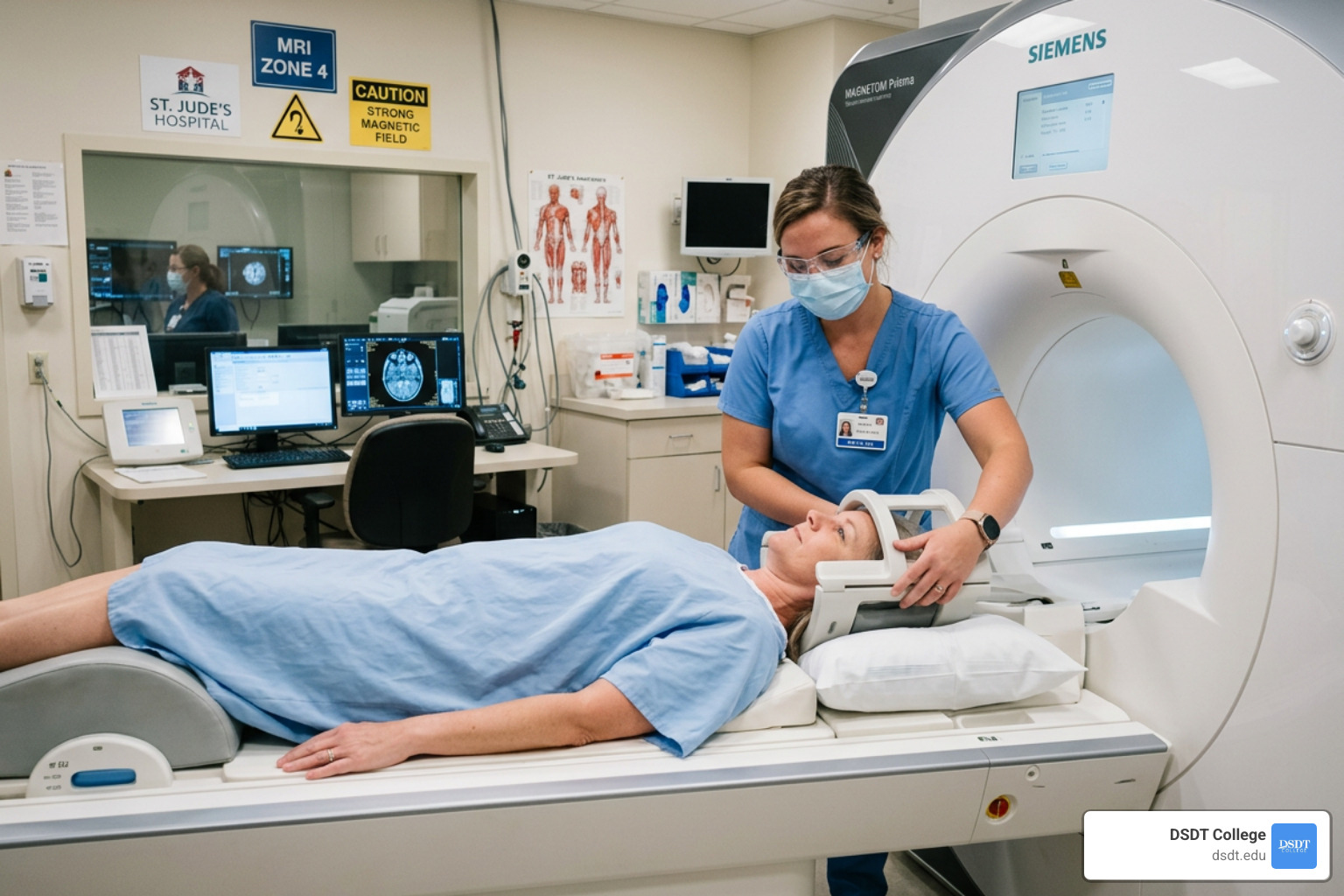
MRI technologists operate powerful magnetic imaging equipment to help doctors diagnose injuries and disease. They work directly with patients, manage safety protocols, and produce detailed images that guide treatment decisions. It is skilled, in-demand work — and getting there requires meeting specific education, clinical, and exam standards.
The path looks different depending on where you are starting from. Whether you are brand new to healthcare or already working as a radiologic technologist, there is a certification route designed for you. This guide breaks down every major requirement so you know exactly what steps to take.
I’m Jamie Kothe, an academic leader and workforce development professional at DSDT College, where I support career-focused programs including allied health imaging. My work aligns training programs with current MRI tech certification requirements and employer expectations, helping students build clear, practical pathways into this growing field. In the sections ahead, we will walk through every step of the certification process in plain language.
Understanding the Primary MRI Tech Certification Requirements
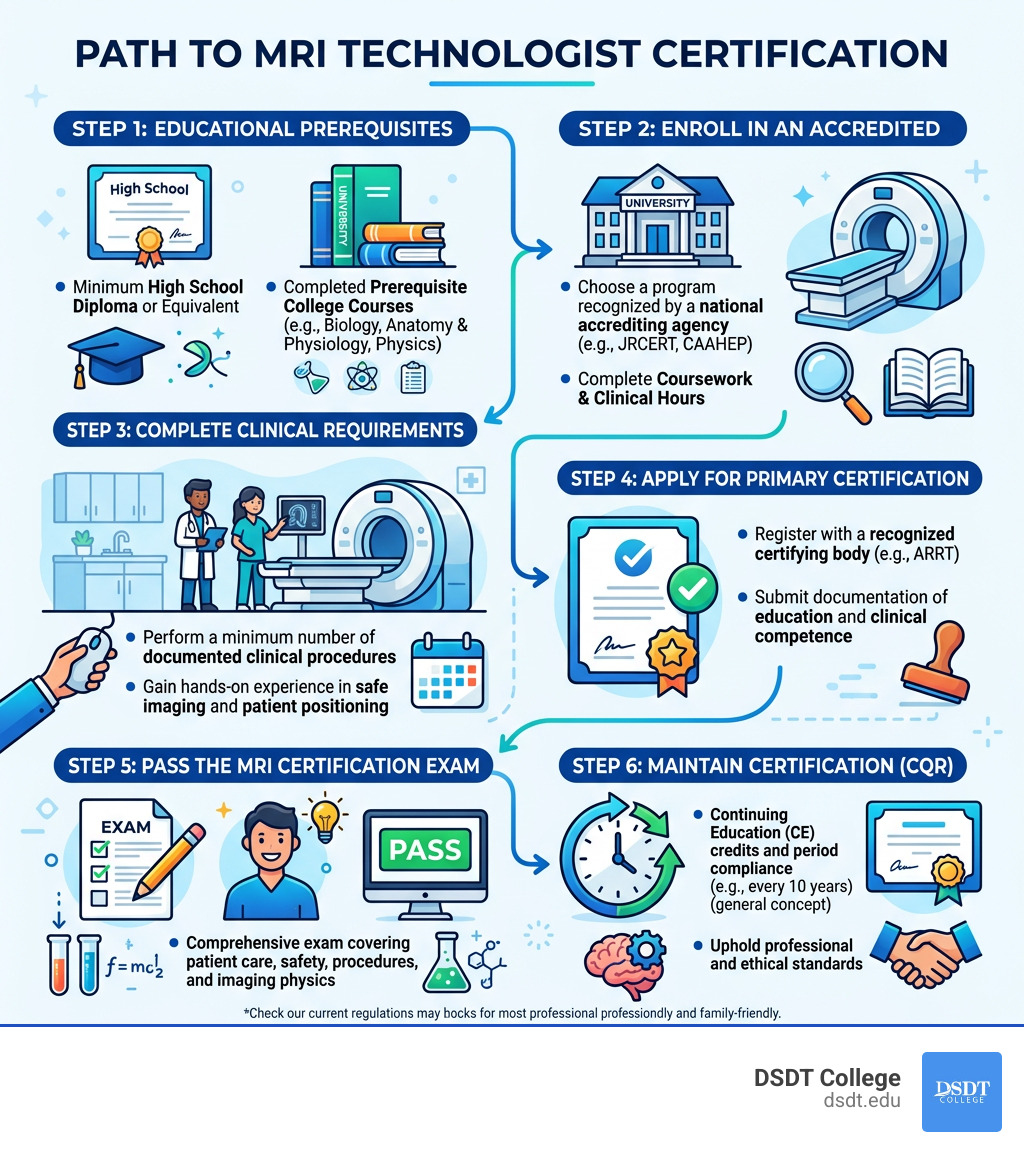
When we talk about the “Primary Pathway,” we are referring to the route taken by individuals who do not yet hold a professional credential in another imaging modality like X-ray or Ultrasound. This is often the most direct route for high school graduates or career changers. The American Registry of Radiologic Technologists (ARRT) sets the industry standard for this path.
To navigate this successfully, we must focus on three main pillars: education, ethics, and examination. First, you must earn an associate degree (or higher) from an institution accredited by a mechanism acceptable to the ARRT. This degree doesn’t necessarily have to be in radiologic sciences, but your MRI program itself must be ARRT-approved.
The ethics requirement is equally vital. We often remind our students that technical skill means little without professional integrity. You’ll need to report any misdemeanor or felony convictions to the ARRT to ensure you meet their character standards before you can sit for the exam.
Finally, the Official ARRT certification requirements culminate in a comprehensive exam. This test isn’t just a formality; it consists of 200 multiple-choice questions covering everything from patient care and safety to image production and physics.
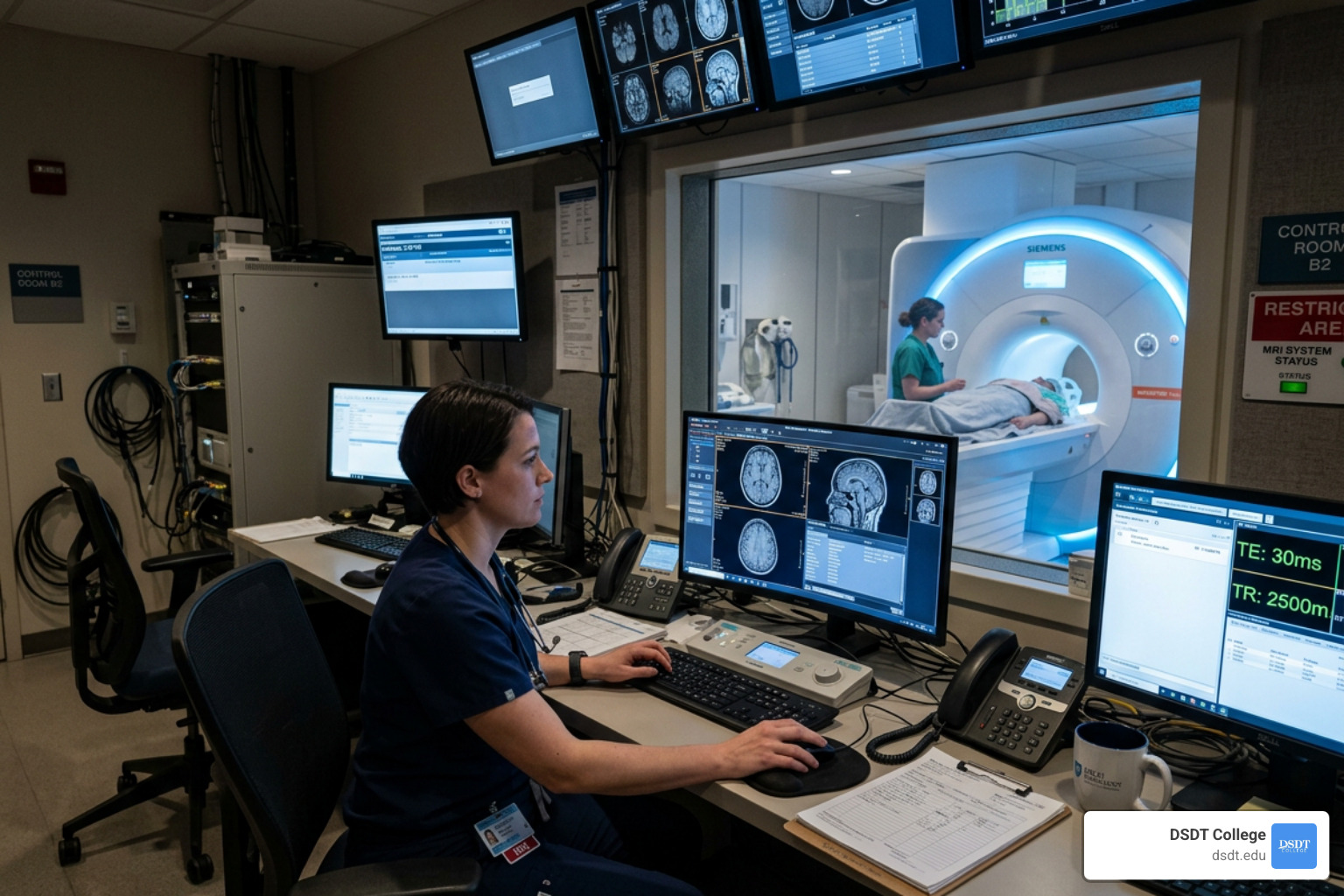
Educational Standards for ARRT MRI Certification Requirements
Quality education is the bedrock of a successful imaging career. The Joint Review Committee on Education in Radiologic Technology (JRCERT) is a primary organization that provides quality assurance for these programs. Following JRCERT educational standards ensures that your curriculum covers the essential “big three” of MRI: Sectional Anatomy, MRI Physics, and Pathology.
In our experience, students often find MRI physics to be the most challenging yet rewarding part of the journey. Unlike X-rays, which use ionizing radiation, MRI uses magnetic fields and radiofrequency pulses. Understanding how atoms in the body respond to these forces is what allows a technologist to create those crystal-clear diagnostic images.
To help you decide which path fits your current status, look at how the eligibility differs:
| Feature | Primary Eligibility | Post-Primary Eligibility |
|---|---|---|
| Target Audience | New students/Career changers | Already certified in Radiography, Sonography, etc. |
| Degree Required | Associate Degree minimum | Already met via primary credential |
| Clinical Focus | Comprehensive entry-level training | 125 specific procedure repetitions |
| Education Focus | Full academic curriculum | 16 hours of structured MRI education |
Clinical Competency and MRI Tech Certification Requirements
You can’t learn MRI solely from a textbook. Hands-on experience is where the “magic” happens. For the primary pathway, the ARRT requires candidates to demonstrate competence in a specific variety of procedures.
Currently, this includes 17 mandatory imaging procedures and 11 elective procedures. These aren’t just “shadowing” hours; you must perform these scans independently (under supervision) on actual patients. The list covers everything from basic brain scans to complex musculoskeletal imaging of the knee or shoulder.
Furthermore, you must prove your skills in “General Patient Care,” such as CPR, taking vital signs, and venipuncture (since many MRI scans require the injection of contrast media). Quality control is another big piece—you’ll learn how to test the magnet’s signal-to-noise ratio and ensure the equipment is safe for every patient who walks through the door. For those looking for a structured environment to meet these goals, you can find More info about MRI Technology Associate Degree programs that integrate these clinical rotations into the schedule.
Alternative Pathways: ARRT Post-Primary and ARMRIT
If you are already a certified Radiologic Technologist (RT), you don’t have to start from scratch. Many of our colleagues in the field began in X-ray or CT and “cross-trained” into MRI. This is known as the Post-Primary pathway.
To qualify this way, you must already hold an ARRT credential in a supporting category (like Radiography or Nuclear Medicine). You then need to document 16 hours of structured education and complete 125 repetitions of MRI procedures. This allows working professionals to transition into MRI while continuing to work in their current roles.
Another reputable option is the American Registry of Magnetic Resonance Imaging Technologists (ARMRIT). While the ARRT covers 15 different imaging credentials, ARMRIT certification options focus exclusively on MRI. ARMRIT views MRI as a distinct specialty that doesn’t belong under the “radiology” umbrella because it uses non-ionizing radiation.
Comparing ARRT vs. ARMRIT Credentials
Choosing between ARRT and ARMRIT often comes down to where you want to work and your educational background.
- ARRT: This is the most widely recognized credential. Most hospitals and large healthcare systems require ARRT certification. Because it’s a “gold standard,” it often provides the most flexibility if you want to move between different states or facilities.
- ARMRIT: This registry is highly respected in specialized MRI clinics and outpatient imaging centers. It is an excellent path for those who attended an MRI-specific vocational program rather than a traditional radiologic technology program.
According to the Bureau of Labor Statistics job outlook, the demand for both types of technologists is strong. However, we always recommend checking with local employers in cities like Detroit, Chicago, or Phoenix to see which credential they prefer. In many cases, having either certification will put you ahead of uncertified applicants, but ARRT remains the most common requirement for hospital-based roles.
State Licensing and Professional Maintenance
Earning your national certification is a huge milestone, but it isn’t always the final step. Around 75% of states require a separate state license to practice legally. While many states use the ARRT or ARMRIT exam scores as the basis for their license, you still have to apply and pay a fee to the state board.
For instance, the Indiana state licensing example shows that the state requires graduation from an approved program and passage of the national exams before they will issue a license. If you are practicing in Michigan, Ohio, or Texas, you must verify the specific “scope of practice” laws in those jurisdictions. Working without a required state license can lead to heavy fines and the loss of your hard-earned credentials.
Continuing Education and Recertification
The medical field moves fast, and MRI technology moves even faster. To ensure we stay sharp, both registries require ongoing learning.
For the ARRT, you must renew your registration every year (usually during your birth month) and complete 24 Continuing Education (CE) credits every two years. Additionally, every 10 years, ARRT technologists undergo Continuing Qualifications Requirements (CQR), which includes a self-assessment to identify any “knowledge gaps” that have developed over the decade. You can stay up to date on these by checking the ARRT ongoing requirements page.
ARMRIT has a slightly different schedule, requiring 24 credits of MRI-specific CME (Continuing Medical Education) every three years. Regardless of the registry, the goal is the same: ensuring that the person operating the multi-million dollar magnet is up to date on the latest safety protocols and imaging techniques.
Career Outlook and Salary Potential
Is the investment in meeting MRI tech certification requirements worth it? The data says a resounding “yes.” As of May 2021, MRI technologists earned a median annual salary of $77,360. For those in the top 10 percent—often those with advanced certifications or working in high-demand metro areas like New York or Dallas—the earnings can exceed $100,000.
The job market is also incredibly stable. The BLS projects a 6% growth in the field through 2031, which translates to about 16,000 job openings every year. This growth is driven by an aging population that requires more diagnostic imaging and the continued expansion of MRI’s capabilities in detecting cardiac issues and various cancers.
For those who want to climb even higher, organizations like the ABMRS safety officer certification offer paths to become a Magnetic Resonance Safety Officer (MRSO). This role is critical in hospital settings, where you oversee the entire safety environment of the MRI suite, protecting both staff and patients from the unique hazards of the magnetic field.
Frequently Asked Questions about MRI Certification
How long does it typically take to become a certified MRI technologist?
If you are starting from scratch, it usually takes between 18 and 24 months to complete an Associate of Applied Science in MRI Technology. This includes your classroom time (didactic) and your clinical rotations. If you are already an RT and are just cross-training, you might be able to complete the requirements in 6 to 12 months, depending on how quickly you can document your 125 clinical repetitions.
Is MRI technologist certification required by law in every state?
Not every single state requires it, but the vast majority do (about 75%). Even in states where it isn’t legally mandated, almost all reputable employers—especially hospitals—will not hire a technologist who isn’t ARRT or ARMRIT certified. Certification is also often required for insurance companies to reimburse the facility for the scans you perform.
Can I transition to MRI if I am already a certified Radiologic Technologist?
Absolutely! In fact, this is one of the most common career moves in the imaging world. You would follow the ARRT Post-Primary pathway. You’ll need to complete 16 hours of structured education (which can often be done online) and then work with an MRI department to perform and document the required clinical procedures.
Conclusion
The journey to becoming a certified MRI technologist is structured and demanding, but it leads to one of the most respected and stable careers in healthcare. By meeting the MRI tech certification requirements, you aren’t just passing a test; you are proving that you have the knowledge and clinical skill to keep patients safe while capturing the images that save lives.
At DSDT College, we are committed to helping you navigate these requirements with confidence. Our Associate of Applied Science in MRI Technology is designed to mirror the ARRT Primary Pathway, providing the hands-on clinical training and rigorous academic foundation you need to succeed. Whether you are in Detroit, Grand Rapids, or any of our Midwest and nationwide locations, we are here to support your transition into this high-tech, high-impact field.
Ready to take the first step toward your new career? You can find More info about MRI Technology Associate Degree and start your application today. Let’s work together to attract the success you deserve.