

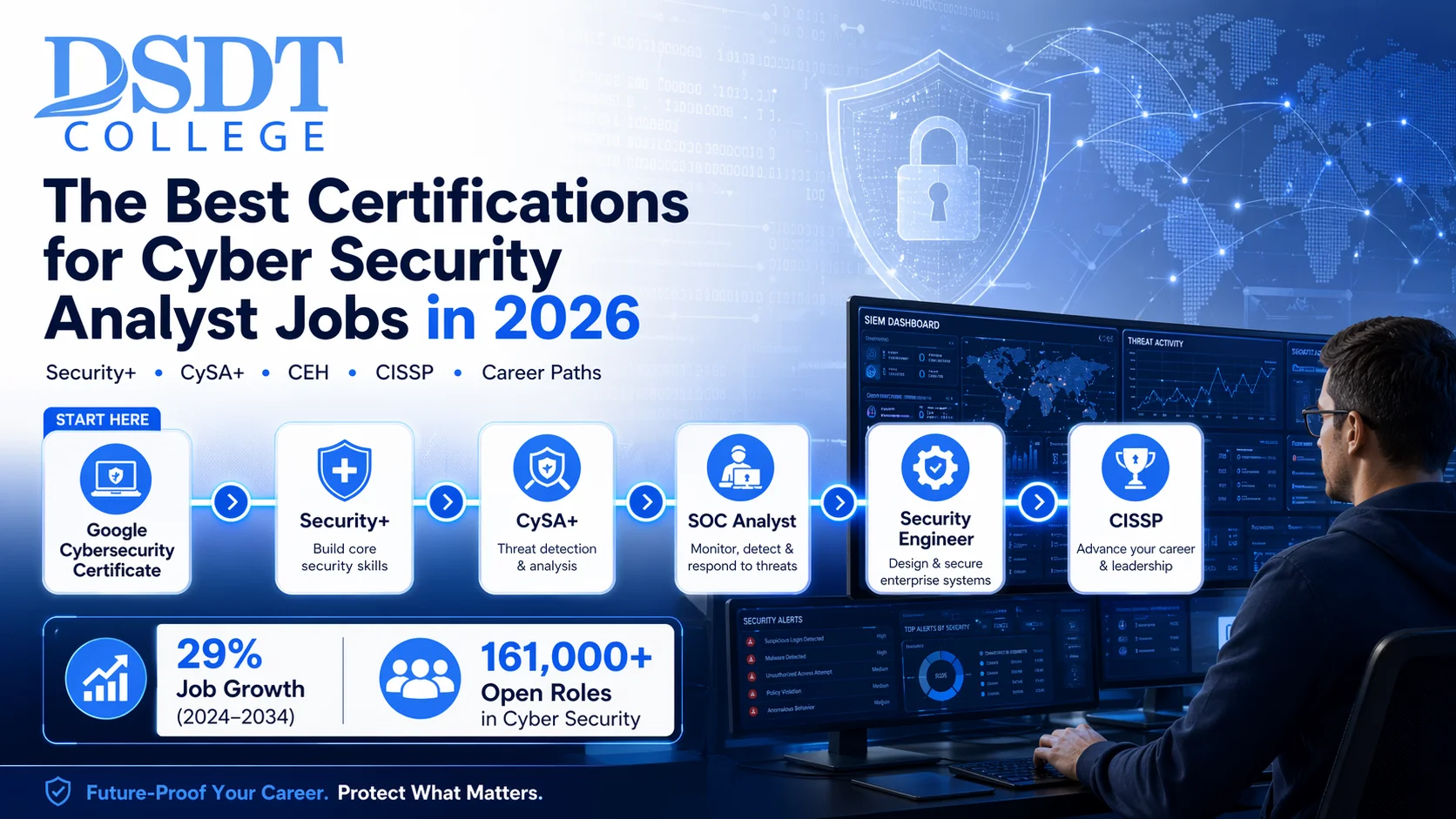
The Best Certifications for Cyber Security Analyst Jobs in 2026
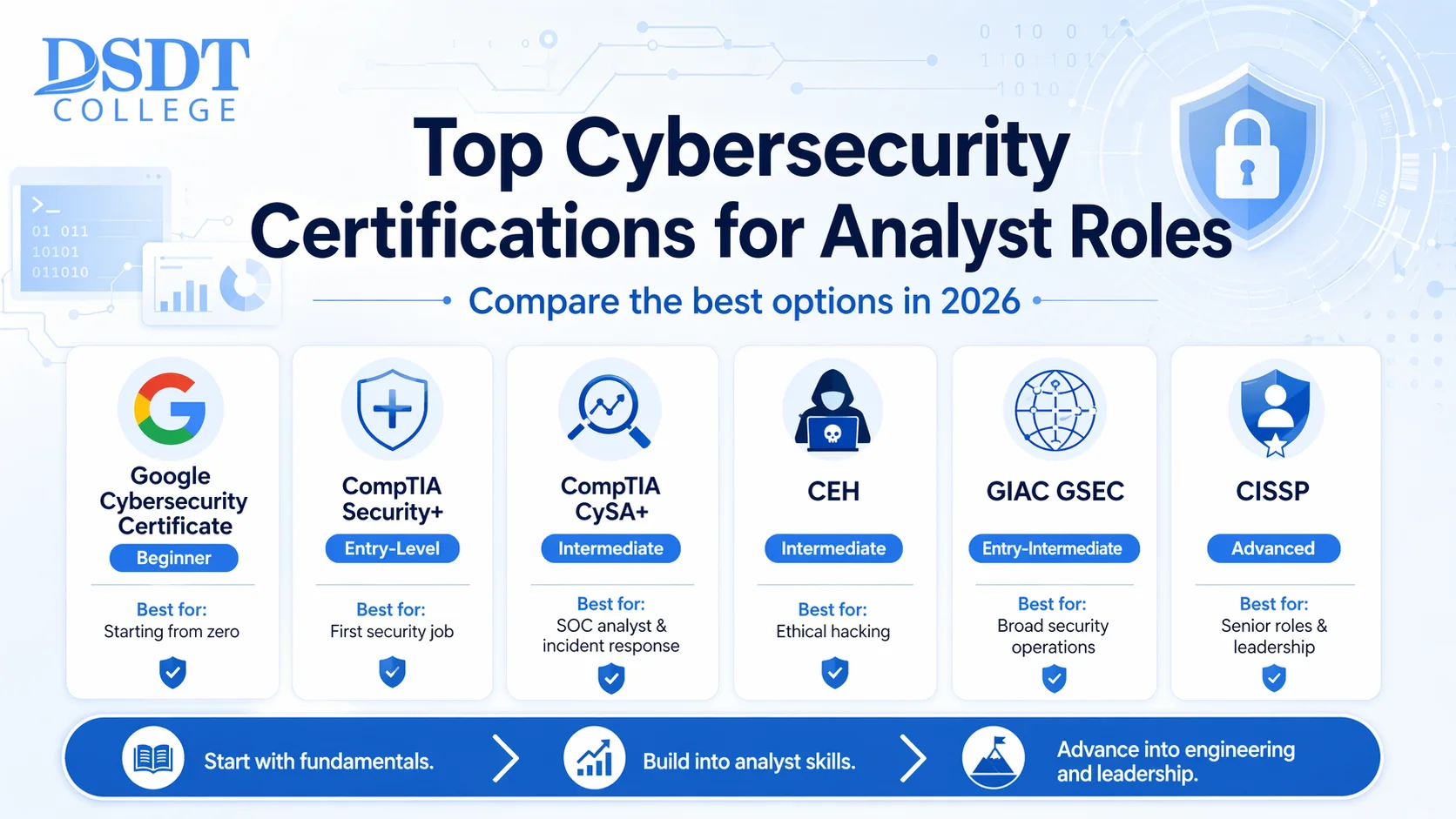
The best certifications for cyber security analyst roles right now are:
| Certification | Level | Best For |
|---|---|---|
| CompTIA Security+ | Entry | First job in security |
| CompTIA CySA+ | Intermediate | SOC analysts, incident response |
| Google Cybersecurity Certificate | Beginner | No-experience starting point |
| CISSP | Advanced | Senior roles, high salary |
| CEH | Intermediate | Ethical hacking, pen testing |
| CISA | Intermediate | Auditors, compliance roles |
| GIAC GSEC | Entry-Intermediate | Broad security operations |
| Splunk Certified Defense Analyst | Intermediate | SOC/SIEM-focused roles |
Cybersecurity is one of the fastest-growing fields in the U.S. right now. The Bureau of Labor Statistics projects 29% job growth between 2024 and 2034 — nearly five times the national average. There are over 161,000 open roles today, and the median salary for professionals with just zero to five years of experience already tops $115,000.
But here is the problem: there are hundreds of cybersecurity certifications out there. Picking the wrong one — or pursuing them in the wrong order — can cost you time, money, and job opportunities.
The right certification does not just prove you know your stuff. It directly determines which job titles you qualify for, how much you can earn, and whether your resume even gets past the first filter.
This guide cuts through the noise and shows you exactly which credentials employers are actually hiring for in April 2026.
I’m representing DSDT College — a nationally accredited, military-friendly institution that specializes in CompTIA-based cybersecurity training, including Security+, CySA+, and PenTest+, helping veterans, active-duty soldiers, and career changers find the right path into security analyst roles and beyond. Whether you’re using Post-9/11 GI Bill® benefits or Tuition Assistance, we’ll show you how to build a clear, accelerated path into this high-demand field.
What Does a Cybersecurity Analyst Do in 2026?
The role of a cybersecurity analyst has evolved into that of a “digital detective.” Organizations no longer just wait for a breach; they rely on analysts to be the eyes and ears of their defense. As an analyst, your primary responsibility is to protect the confidentiality, integrity, and availability of an organization’s data and systems.
According to the NICE Framework work roles, analysts typically fall into categories like Cyber Defense Analyst or Incident Responder. On a daily basis, you will:
- Monitor Networks: Use SIEM (Security Information and Event Management) tools like Splunk or Chronicle to watch for anomalies.
- Investigate Breaches: Conduct digital forensics to understand how an attacker got in and what they touched.
- Threat Hunting: Proactively search for hidden threats that haven’t triggered alarms yet.
- Vulnerability Management: Scan systems for weaknesses and prioritize which ones need fixing first.
The Cybersecurity Analyst Certificate skills required for these tasks include proficiency in Linux, SQL, and Python automation. At DSDT College, we emphasize these hands-on skills in our Information Technology Associate Degree and specialized certificate tracks to ensure you aren’t just passing a test, but are ready to defend a real network on day one.
The Best Certifications for Cyber Security Analyst Roles in 2026
When evaluating industry-standard credentials, we must look at what employers are actually asking for in job descriptions. It’s a mix of vendor-neutral foundational knowledge and specialized technical depth.
CompTIA Security+
This is the “gold standard” for starting out. It is held by over 265,000 professionals and is mentioned in more than 70,000 job openings. It is often a mandatory requirement for Department of Defense (DoD) roles under the DoD 8140/8570 mandates. If you want a job as a Security Analyst ($111,698 avg salary), this is usually your first step.
CompTIA CySA+ (Cybersecurity Analyst+)
While Security+ is broad, CySA+ is deep. It focuses specifically on incident response and vulnerability management. The current V3 exam emphasizes continuous security monitoring and proactive threat detection. This is the premier certification for those aiming for a Security Operations Center (SOC) role.
GIAC GSEC and GCIH
GIAC certifications, often paired with SANS training, are highly respected but come with a higher price tag (often around $2,499). The GSEC covers broad security essentials, while the GCIH is the go-to for incident handling.
New Qualifications and Global Standards
The landscape is always shifting. For example, the New Level 4 qualification for security professionals highlights a global push for standardized, high-level training. Whether you choose vendor-neutral paths like CompTIA or vendor-specific ones, the goal is to align with the Technology Professional 6 program standards that employers trust.
Which Entry-Level Options are Best for Beginners?
If you are starting from zero, the barrier to entry has never been lower thanks to high-quality certificate programs.
- Google Cybersecurity Certificate: This is an incredible starting point. It requires no prior experience and prepares you for roles like SOC Analyst. A major perk? Completing it gives you a discount on the CompTIA Security+ exam, allowing for “dual credentialing” that looks great on a resume.
- IBM Cybersecurity Analyst Professional: This program on Coursera covers 14 courses, including data protection, endpoint security, and even generative AI for cybersecurity. It’s ACE® approved, meaning it can count toward college credits.
- SSCP (Systems Security Certified Practitioner): Offered by (ISC)², this is a solid alternative to Security+ for those who want to start their journey with the same organization that issues the famous CISSP.
When asking what certifications do you need for cybersecurity?, the answer for beginners is usually a foundational certificate followed by a major industry certification like Security+.
Comparing Specialized Certifications
Once you have the basics, you might want to specialize. This is where you move from a generalist to a high-paid specialist.
- Ethical Hacking: The Certified Ethical Hacker (CEH) is one of the top 11 cybersecurity certifications that will get you hired. It teaches you to think like a hacker to better defend your network.
- Auditing: If you prefer the compliance and “paperwork” side of security, the CISA (Certified Information Systems Auditor) is mentioned in over 52,000 job openings and leads to roles like Information Security Analyst ($140,653 avg salary).
- SIEM Mastery: The Splunk Certified Cybersecurity Defense Analyst is an intermediate-level cert for those who want to be power users of the industry’s most popular monitoring tool.
- Hands-on Ops: The CCOA (Certified Cybersecurity Operations Analyst) from ISACA focuses on technical proficiency with open-source tools like Wireshark and Security Onion.
For those interested in the intersection of tech and business, our Business Information Technology Specialist program provides the perfect backdrop for these specialized certs.
Mapping Your Career Progression: From SOC Tier I to Security Engineer
Your journey doesn’t end with your first analyst job; professional requirements evolve as you climb the ladder.
- Tier I SOC Analyst: You’ll likely start here with Security+ or a Google Certificate.
- Tier II/III Analyst: You’ll add CySA+ or GCIH to your resume.
- Security Engineer: This role often commands an average salary of $157,496. You might transition here by gaining skills in our Full Stack Developer program to understand how applications are built and broken.
- Management/Senior Leadership: This is where the CISSP (Certified Information Systems Security Professional) becomes essential. It requires 5 years of experience but is the most in-demand cert in the industry, mentioned in over 82,000 job openings.
According to the Ultimate Guide to Cybersecurity Certifications, the CISSP is often the “gatekeeper” for six-figure management roles. For those who want to stay on the technical side, the CASP+ (CompTIA Advanced Security Practitioner) is a great alternative that doesn’t require the same management focus. You can explore more Cybersecurity Programs and training to find the right fit for your five-year plan.
Frequently Asked Questions
Can I get a cybersecurity analyst job with no experience?
Yes, but you need a “bridge.” Certifications like the Google Cybersecurity Certificate or CompTIA Security+ act as that bridge. At DSDT College, we help career changers and high school grads bypass the four-year degree requirement through accelerated, career-focused training.
Which certification is most in-demand by employers in 2026?
The CISSP remains the most mentioned in job postings for senior roles, while CompTIA Security+ is the most required for entry-level and government-contractor positions.
How much do cybersecurity analyst certifications cost?
Costs vary widely:
- CompTIA Security+: ~$400
- Google Certificate: ~$49/month (subscription-based)
- CEH: ~$1,199
- CISSP: ~$749
- GIAC Certs: ~$2,499 Many employers (about 40% according to industry stats) will actually pay for your certification costs once you are hired!
Conclusion
The path to becoming a cybersecurity analyst is clearer than ever. By choosing the right foundation—like Security+ and CySA+—you are positioning yourself for a stable, high-paying career in a field that desperately needs your skills.
- Fort Hood CSP: We offer a strictly in-person Cybersecurity SkillBridge program at Fort Hood for transitioning service members. This CSP is dedicated solely to Cybersecurity training.
- Online Flexibility: Other programs, such as the MRI Technology Primary Pathway, are available 100% online and are not part of the in-person SkillBridge track. These are ideal for military spouses using MyCAA or individuals utilizing their educational benefits.
- Speed to Career: We have no waitlists and no SAT/ACT requirements, focusing on getting you trained and certified quickly.
Ready to secure your future? Apply for our Cybersecurity and IT programs today, or check out our Financial Aid options to see how you can get started.